

Wall Street bid and bonds rise as oil slides

Jamie Dutta >
Market Analyst
Jamie Dutta >
Market Analyst
Jamie Dutta is a Market Analyst for Vantage. He comes with extensive experience as a full-time trader and financial market commentator, having worked as a trader in top tier investment banks and trading houses.

* Trump threatens more Kharg strikes, help with Hormuz falls flat
* USD, Treasury yields drop as investors track lower oil prices
* Stocks bounce to start central bank-heavy week
* Nvidia expects to make $1 trillion from AI chips through 2027
FX: USD found resistance again at the November high at 100.39 and pulled back quite sharply. Market sentiment was more positive with relief that Middle East events haven’t escalated. Attempts to escort convoys through the Strait of Hormuz are the latest White House idea to calm oil markets, though allies are said to rejected this. Crude prices came off early Asian session highs and are back below $100. There were also reports about US-Iran messages concerning ending the war. Eight of the G10 central banks meet this week with the Fed battling elevated inflation and poor recent labour market data.
EUR bounced back after four straight days of losses versus the dollar. The world’s most popular currency pair traded back above the November 2025 low at 1.1468. This week’s ECB meeting could see a hawkish tilt with policy makers ready to act if needed if oil-driven inflation shocks persist.
GBP also rebounded after four days of selling. Sterling was mid pack with its peers with eyes on this week’s jobs data and BoE meeting. Rate cuts have recently been priced out but hints on how long that might last will be key this week.
JPY hit resistance again at 159.74 as markets were spooked by intervention threats. It was around here that the MoF and the New York Fed were said to have ‘checked’ prices a few weeks ago. Thursday’s BoJ meeting will leave policy unchanged with the yen probably moved more by the global risk mood than BoJ policy just yet. That said, clues from Governor Ueda on any hikes going forward will be important.
US stocks: The S&P 500 added 1.51% to close at 6,702, the Nasdaq was 1.13% higher at 24,655 and the Dow Jones settled higher by 0.83% at 49,946. The Dow again underperformed after it was the only major index to touch the 200-day SMA at 46,485 on Friday. Technology, Consumer Discretionary and Communication Services led the gainers with Consumer Staples and Energy lagging, though every sector was in the red. Nebius jumped 15% as it signed a $12bn AI capacity deal with Meta, with the latter to spend up to $27bn over five years. Meta rose 2.2% who had to deny rumours of big layoffs which could impact 20% of its workforce.
Asian stocks: Futures are green. APAC stocks were red after the weekend’s military action in the Middle East. The ASX 200 was down on weakness in mining, materials and tech, ahead of the RBA meeting. See below for more. The Nikkei 225 dipped with losses in electric and utilities. The Hang Seng and Shanghai Composite were mixed after stronger than expected activity data and US-China trade talks.
Gold slipped below $5,000. The elimination of Fed rate cut bets is impacting bullion, while profit taking is ongoing with a relatively higher dollar still hurting bugs. A major US investment bank updated their Brent crude price forecasts – Q2-2026 $110 (previously $80), Q3-2026 $90 (was $70), Q4-2026 $80 (was $65.00), H1-2027 $70 (was $65) and H2-2027 $70 (was 65.00).
Day Ahead – RBA Meeting
Money markets price in over a 70% chance for a 25-bps hike, which would take the cash rate from 3.85% to 4.1%. The latest inflation, growth and labour market data has all been strong. Governor Bullock recently said there is a live chance of a March hike given the inflation risks tied to the Iran war. Commentary from other RBA officials has continued to emphasise the bank’s pessimistic view on supply capacity, concerns over the persistence of domestic inflation and official’s desire to keep price expectations anchored. Policymakers are now also facing the additional threat from offshore in the form of surging energy prices. This points to the RBA likely feeling compelled to act without delay, even though current global uncertainty does give officials a chance to assess inflationary pressures if they wished.
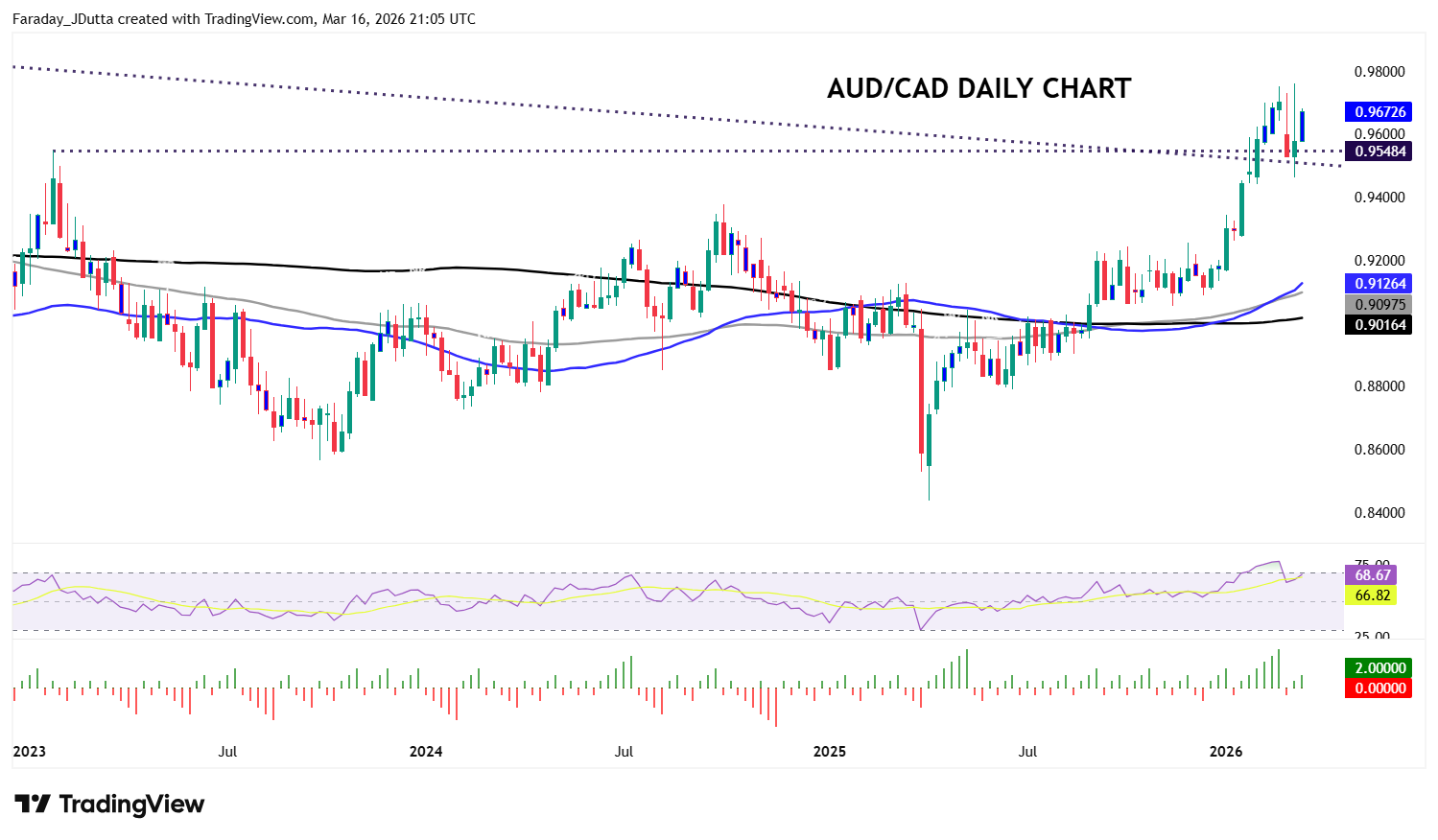
Chart of the Day – AUD/CAD above long-term support
The aussie and loonie have been neck and neck just below the US dollar as the best performing major over the past month. Wednesday’s Bank of Canada meeting is likely to keep messaging relatively neutral but give a nod to the recent volatility in oil prices and their potential impact on growth and prices. Weak jobs data and easing core inflation argue against any nearer‑term hikes, so too trade and tariff uncertainty. The cross recently traded up to levels last seen in June 2021 as the more hawkish RBA trumped the BoC, amid rising commodity prices boosting both currencies. Prices briefly dipped below the January 2023 top at 0.9584 and the long-term downward trendline from the February 2012 high. But that has proved strong support with bulls eyeing up fresh highs if they can bust through the recent resistance around 0.9750/9.