

Stocks mixed on mixed geopolitical reports

Jamie Dutta >
Jamie Dutta >
Jamie Dutta is a Market Analyst for Vantage. He comes with extensive experience as a full-time trader and financial market commentator, having worked as a trader in top tier investment banks and trading houses.

* US-Iran may hold high-level peace talks as soon as Thursday
* Dollar holds gains due to Iran conflict uncertainty
* Oil flat after gains given back on modestly positive Iran headlines
* Stocks little changed as Wall Street tries to build on Monday’s rally
FX: USD steadied as Treasury yields picked up again after losses to start the week. The 10-year is not far away from fresh 8-month highs again. There was much conflicting news flow, from all three sides in truth, making it tough to make any firm long-term views. It seems the worst scenario of military strikes on energy and water infrastructure may be off the table for now. Late headlines saw the dollar give back gains as President Trump suggested goals are nearly reached and Iran had agreed to negotiate. Risk appetite was muted which meant an underlying bid for the greenback remained through most of the day. Strong resistance sits at recent and November highs around 100.34/54.
EUR was a relative outperformer but still closed lower on the day. The news of the 5-day pause in strikes helped the euro while we had more ECB officials talking about rate hikes. There are around 3 quarter point moves priced in for this year, from above four yesterday morning. PMIs were mixed with manufacturing surprising to the upside but services disappointing, with France notably below 50 and into mild contraction.
GBP dipped as cable struggled to get above the 200-day SMA at 1.3430 and the 50% marker of the November to January move at 1.3439. Geopolitics is the key driver, as PMIs also gave us a mixed read on business activity. Similar to the eurozone, manufacturing came in better but there was a slight disappointment in services, though both were in mild expansion hovering just above the neutral threshold at 50. BoE’s arch-hawk Pill said he stands ready to act against inflationary pressures as upside risks to price stability are mounting.
JPY weakened on higher Treasury yields as the major consolidated below the strong resistance zone around 159.50/160. As we said yesterday, that was probably the line in the sand for FX interventions before the Iran conflict, but there is an obvious disincentive to intervene in a volatile market. Softer CPI is likely to be looked through by the BoJ with healthy wage talks and firmer than expected PMIs supporting the chance of an April rate hike.
US stocks: The S&P 500 lost 0.37% to close at 6,556, the Nasdaq was 0.77% lower at 24,002 and the Dow Jones settled lower by 0.18% at 46,124. All three main indices remain below their 200-day SMAs. The VIX, Wall Street’s fear gauge, remained elevated at 26. The March high sits just above 35. Energy and Materials were the main sector leaders while Communication Services was the real big laggard. That’s because it includes software names which were hit on more private credit redemption caps from Apollo and Ares, while Claude also released a new tool, sparking renewed AI disruption concerns. United Airlines warned of a 20% fare hike to cope with oil surge, Bloomberg reported.
Asian stocks: Futures are mixed. APAC stocks rose on the back of positive Wall Street performance. The ASX 200 climbed with strength in miners, resources and materials offsetting tech and financials weakness. The Nikkei 225 moved above 52,000 but oil headwinds linger. The Hang Seng and Shanghai Composite gained with tech helping Hong Kong.
Gold eventuallyclosed higher, avoiding a tenth straight day of losses which would have been its worst losing streak on record. The Iran conflict has added to inflationary risks, reinforcing expectations that interest rates could stay higher for longer, a headwind for non‑yielding assets such as gold.
Day Ahead – Australia and UK CPIs
Headline Australia inflation is forecast to stay steady at 3.8% and the trimmed mean at 3.4%. The six-month annualised rate may tick up to 3.6%, but that is still below the December 3.7% reading. February is a seasonally softer month and fuel prices were still falling through the month too. The recent RBA meeting saw officials debate the timing of the hike and not whether to tighten, with some alarmism about CPI more broadly, and especially with the uncertainty around the Middle East conflict.
Consensus predicts unchanged UK headline inflation at 3% and core at 3.1%, with services down two-tenths at 4.2%. The data is before the recent energy-driven price spike, which won’t show up until Q3. Last week’s BoE meeting was hawkish due to inflation concerns and second round effects, and subsequent huge repricing of rate hikes. There were around 100bps priced in for 2026 at one point yesterday morning before the Trump messaging saw that pared back to around 60-65bps.
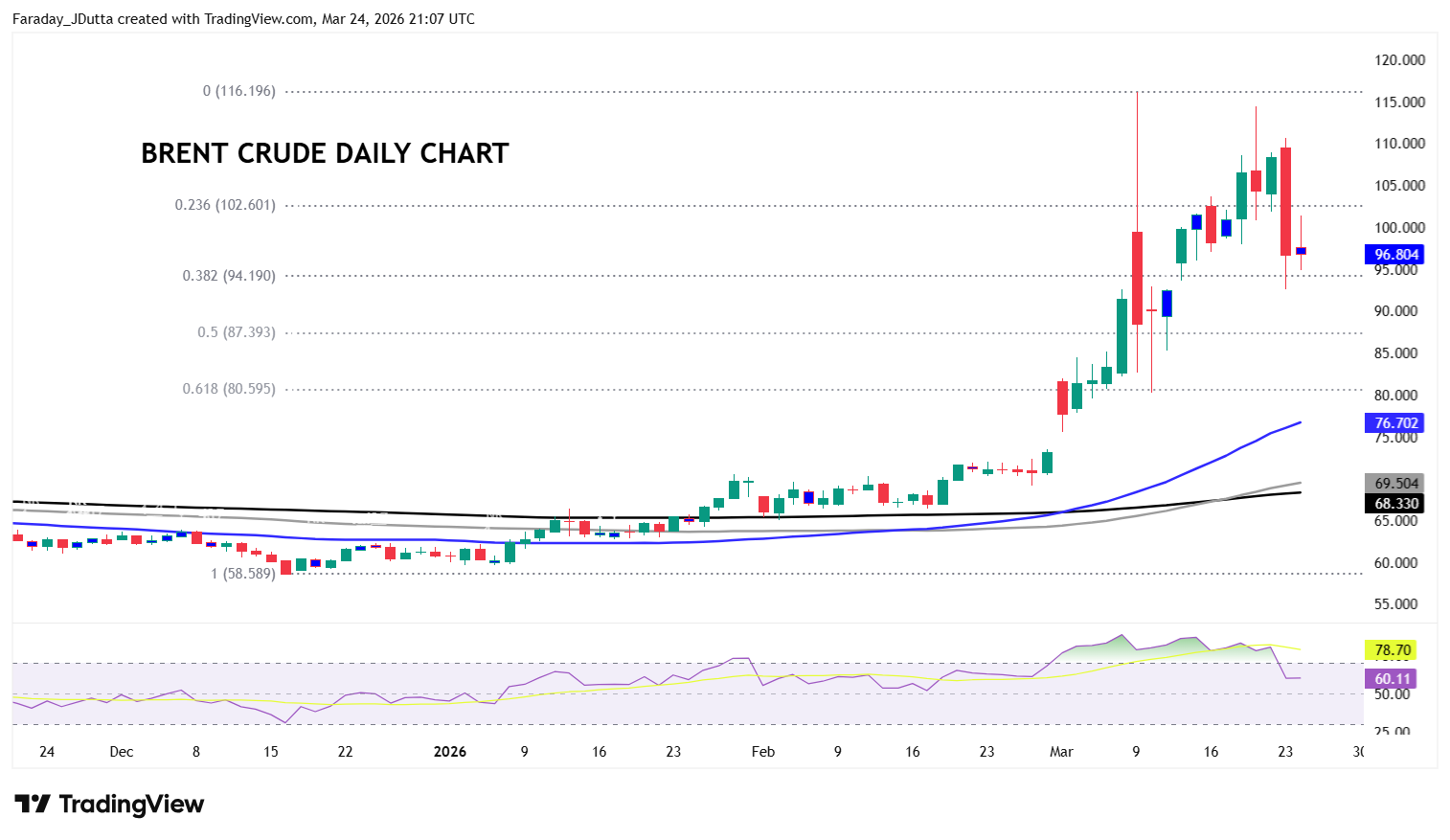
Chart of the Day – Oil trades below $100
The International Energy Agency has described the current situation in the Middle East as the biggest oil supply disruption in history, highlighting the vulnerability of predicting any outlook, despite some of the latest headlines. Brent crude saw one of its sharpest intraday swings on record on Monday, after President Trump signalled the potential de‑escalation with Iran, triggering a sharp move lower in crude. Prices fell as much as 14% towards $92 following Trump’s comments, before recovering to trade near $102 after Iranian media reported there had been no direct communication with the US. Brent eventually closed under $100 for the first time since March 11. Trade was choppy yesterday on mixed messaging and headlines. A major Fib level (38.2%) of the December to March move sits at $94.19, with the minor retracement level at $102.60.