

Market chop continues with small crude upside

Jamie Dutta >
Market Analyst
Jamie Dutta >
Market Analyst
Jamie Dutta is a Market Analyst for Vantage. He comes with extensive experience as a full-time trader and financial market commentator, having worked as a trader in top tier investment banks and trading houses.

* IEA to release record 400mn barrels from oil reserves
* US CPI report shows inflation held steady in February
* Stocks end mixed as Iran tensions outweigh tame inflation
* Dollar modestly higher as Treasury yields climb
FX: USD gained against all its peers apart from AUD as markets battled once again with competing headlines. Ongoing military action has seen geopolitical tensions pick up after the calm from President Trump’s comments at the start of the week. Treasury yields ticked up to one-month highs as the 10-year crossed the 200-day SMA at 4.17%. There are now only 30bps priced in for 2026 versus 39bps yesterday. The February CPI data posted inline relatively benign numbers. But this report was before the Iran conflict which will cause energy costs to rise amid concerns about supply bottlenecks in the region. The headline figure is expected to tick up from 2.5% to 3%+ in the coming months. However, demand destruction comes into play the longer energy costs stay high, which means cooler prices over the medium to long term. The IEA reserve release is seen as short-term.
EUR moved lower after Tuesday’s price action saw resistance at the 200-day SMA at 1.1671 trump the bullish outside candle posted on Monday. ECB comments have leaned hawkish with money markets pricing close to a full 25bps rate hike by September. President Lagarde has said she wouldn’t allow Europe to experience the same inflationary pressures as the post-Ukraine invasion. Monday’s low is 1.1507.
GBP dipped below the 200-day SMA at 1.3440. The midpoint of the November to January low to high move sits at 1.3439 with the next major Fib below at 1.3338. A member of the OBR expressed concerns about the implications of the Iran conflict on inflation forecasts. Their year-end projection had CPI dropping from 3% to 2%.
JPY weakened as rising Treasury yields hurt the yen, along with rising energy prices. This week’s spike high is 158.90 with potential intervention levels around 159/160. The effectiveness of any intervention is being questioned as the Iran conflict continues. Cooler than expected PPI figures also supported a go-slow in BoJ policy normalisation.
US stocks: The S&P 500 lost 0.08% to close at 6,776, the Nasdaq was 0.03% higher at 24,965 and the Dow Jones settled lower by 0.61% at 47,417. Only three sectors were in the green, with Energy by far the biggest outperformer. Consumer Staples, Real Estate, Financials and Utilities were the major losing sectors. This week has seen Tech leadership more broadly continue, with growth/momentum stocks doing particularly well. This is a trend shift from most of this year, with value outperforming growth by almost 10% year-to-date before the Iran attacks. This is especially notable when Treasury yields have risen too. Oracle helped Tech with beats on both revenue and earnings and demand for cloud computing for AI growing faster than supply. In fact, it was the first quarter in 15+ years where total revenue and EPS both grew 20%+. ORCL is seemingly transitioning from a traditionally seasonal, license-based business into a highly predictable, recurring revenue cloud giant. JPMorgan marked down certain loans held by private credit groups and is tightening lending to the sector.
Asian stocks: Futures are mixed. APAC stocks were higher as regional stocks shrugged off the muted price action Stateside. The ASX 200 saw strength in miners, materials and financials leading. The upside was capped by hawkish rhetoric around next week’s RBA meeting. The Nikkei 225 rallied on softer PPI data and modest oil price easing. The Hang Seng and Shanghai Comp underperformed with Chinese officials said to be frustrated by US preparation for the upcoming Trump-Xi summit at the end of the month.
Gold printed an inside day as bullion steadied amid rising yields and the dollar. Competing drivers are making it tough for bugs to gain any big bullish momentum.
Day Ahead – Headline havoc
This week has been interesting to trade with so many conflicting stories, headlines and general broader narratives. The world was ending on Monday, war was over on Tuesday and Wednesday had us somewhere in between. That makes for choppy markets, though certainly that is good for intraday short-term traders. The longer we go without any kind of potential ceasefire, with still minimal shipping traffic and oil flows, it seems the more nervous the market will get. Iran seemingly has the oil price to use as leverage, though inevitably that also harms everyone.
Away from the Middle East, credit concerns are bubbling under, with JP Morgan marking down portfolios due to their exposure to the software sector that could be disrupted by AI. Private credit’s biggest firms like Blackstone have been caught up in the sharp sell-off, as they have increasingly focused on corporate lending over buyouts in recent years. We will be watching for potentially more “cockroaches” as JPM’s Jamie Dimon remarked late last year.
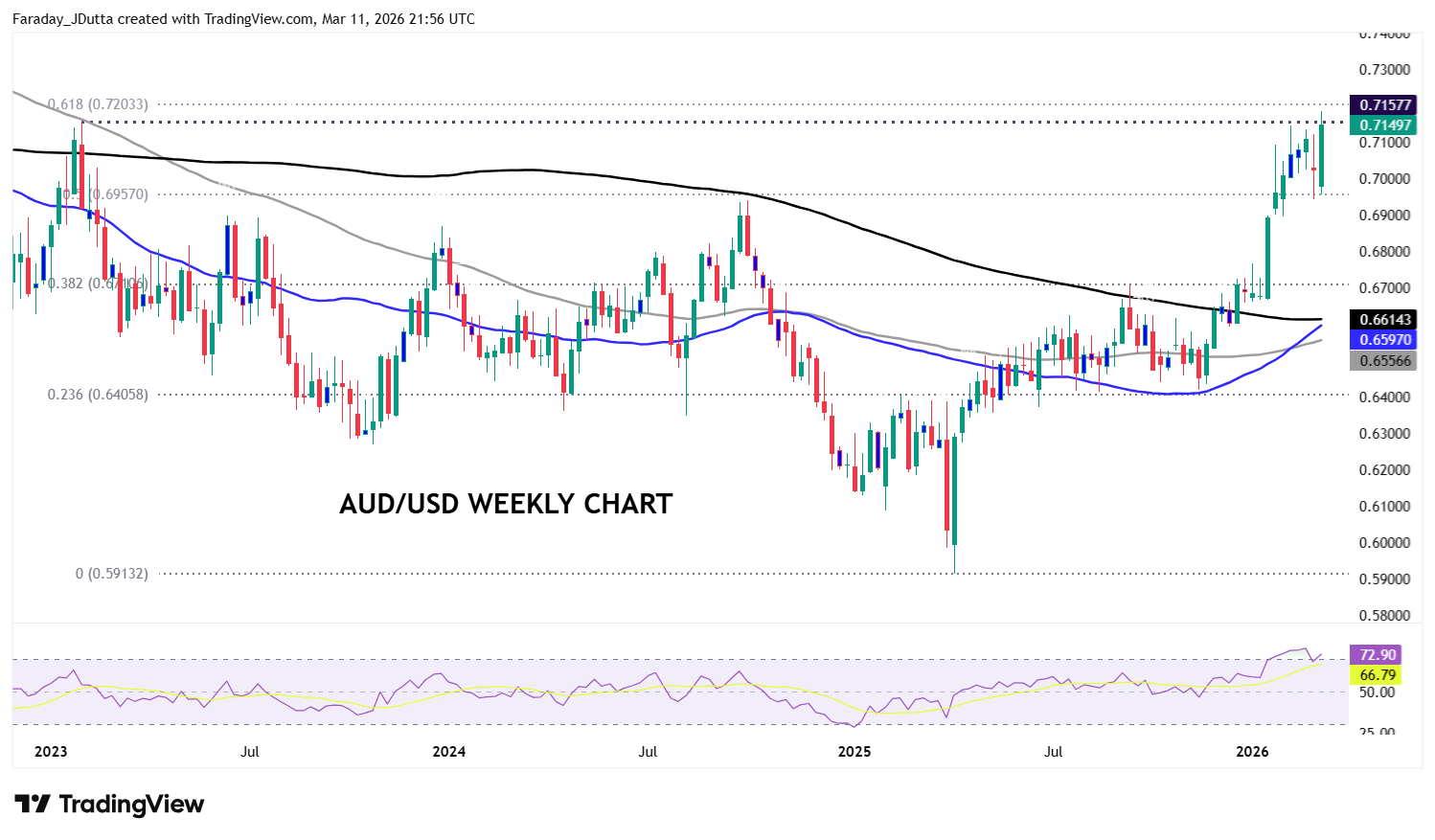
Chart of the Day – AUD hits near 4-year highs and resitance
AUD has outperformed in recent weeks and it hit near 4-year highs at 0.7187 before paring gains yesterday. Next week’s RBA meeting is in focus with many Wall Street economists now expecting another rate hike. The bank will be ‘compelled to react’ due to the recent oil price strength, while domestic inflation is far beyond the 2-3% target band. Back-to-back RBA rate hikes were also possibly signalled by comments from bank officials recently, who are increasingly concerned over potential inflationary pressures from the Iran war. The aussie has fared relatively well despite the shock caused by the conflcit. This is due to the positive terms of trade dynamics and supportive domestic economic growth. Resitance sits a this year’s high at 0.7147, which is reinforced by the January 2023 peak at 0.7157. A long-term Fib retracement level of the 2021 high to the Apirl 2025 low resides at 0.7203.