

Dollar higher as Middle East war continues

Jamie Dutta >
Jamie Dutta >
Jamie Dutta is a Market Analyst for Vantage. He comes with extensive experience as a full-time trader and financial market commentator, having worked as a trader in top tier investment banks and trading houses.

* Bessent states global oil market well supplied, US can regain control of Straits
* Fed Chair Powell says there’s tension currently between Fed’s two mandates
* Crude drops on Bessent comments, USD hit fresh cycle highs
* S&P 500 falls after early rally as Iran war intensifies
FX: USD rose for a fifth straight day, as the index came into strong resistance at recent and November highs around 100.34/54. Again, we’ve had lots of geopolitical news flow, with the mood muted as we head into an ‘escalate to de-escalate’ phase. That could mean boots on the ground as Trump looks to secure Kharg or other islands which handle over 90% of Iran’s oil exports. Separately, The Times of Israel reported that Israel is shifting to targeting Iran’s economy as it enters the “completion phase” of the war. This week has a lot of top tier data, closing the week with NFP on Good Friday, a US market holiday.
EUR fell below the November low as it performed midpack in the majors versus the dollar. The odds of an April ECB rate hike recently dropped from 85% to 50% in part because of officials’ commentary. On Friday, ECB’s Schnabel said the bank should not rush its response to developments, nor overreact. Monday saw German regional CPI data print hot for March on rising energy prices. The mid-March low sits at 1.1410.
GBP underperformed as cable slid to fresh 4-month lows. A minor fib level of the November to January move resides at 1.3193. That November low is 1.3010.
JPY strengthened and outperformed as the major printed a fresh cycle high at 160.46 in Asian hours before paring losses. Hawkish BoJ minutes and continued verbal intervention from Japanese officials helped the yen eventually outperform its peers.
US stocks: The S&P 500 lost 0.39% to close at 6,344, the Nasdaq was 0.78% lower at 22,953 and the Dow Jones settled higher by 0.11% at 45,217. The broad based S&P 500 closed a fifth straight week lower with the Nasdaq and Dow Jones in correction territory, so off more than 10% below their record highs. Only three sectors were red – Energy, Tech and Industrials. Financials, Utilities and Consumer Staples led the gainers. Memory stocks continued to get hit following the recent announcement from Google that its TurboQuant algorithm can cut the amount of memory required to run large language models by at least a factor of six. Micron fell 9.9% and is now down over 30% the recent record high. Sandisk dropped more than 7%, Western Digital 8.6%, and Applied Materials 4.1%.
Asian stocks: Futures are mixed. APAC stocks were lower as the Houthis, the Yemen rebel group, entered the conflict by firing missiles towards Israel. The ASX 200 saw tech and financials lead the downside with energy and commodity sectors offsetting losses. The Nikkei 225 was pressured by higher oil prices and hawkish BoJ minutes. The Hang Seng and Shanghai Composite were mixed with BYD and bank earnings, and trade tensions evident.
Gold built on its (marginally) higher week – the first since the Iran war started – as bargain hunters pushed bullion higher, though gains were given back through the day. The weekly candle was a firm rejection of lower prices and prices have consolidated above the October top at $4,380 over the last few sessions. The 100-day SMA sits above at $4,610. Falling Treasury yields also gave bugs some respite.
Brent crude popped higher in Asian hours before giving up some gains. Futures remain extremely elevated as prices rise further into the next 12 months. There is now talk about demand destruction regarding high oil prices. That means more concerns over lower growth than higher inflation. In turn, a fiscal government stimulus bill is being discussed.
Day Ahead – Eurozone Inflation
After hovering for a long time around the 2% mark, higher energy prices are now expected to push headline inflation up, as they did in 2022. The question is, how large and sustained any jump in inflation might be. Consensus sees the March headline ticking up to 2.6% from 1.9% in February. The core, which excludes energy prices, is forecast to remain steady at 2.4%. The ECB’s ‘good place’ policy seems over with higher energy prices lifting the headline prints. Inflation expectations and second round effects are crucial. Otherwise, Private sector growth in the euro zone slowed sharply in March, with input costs rising to their highest in more than three years and supply chains being significantly disrupted.
Altogether, economic data for March could ramp up pressure on the ECB to hike rates as soon as next month – something that seemed almost unthinkable before the Iran war but is now being heavily priced in by money markets. There’s around a 50% chance of an April rate hike, which has been reined in over recent days.
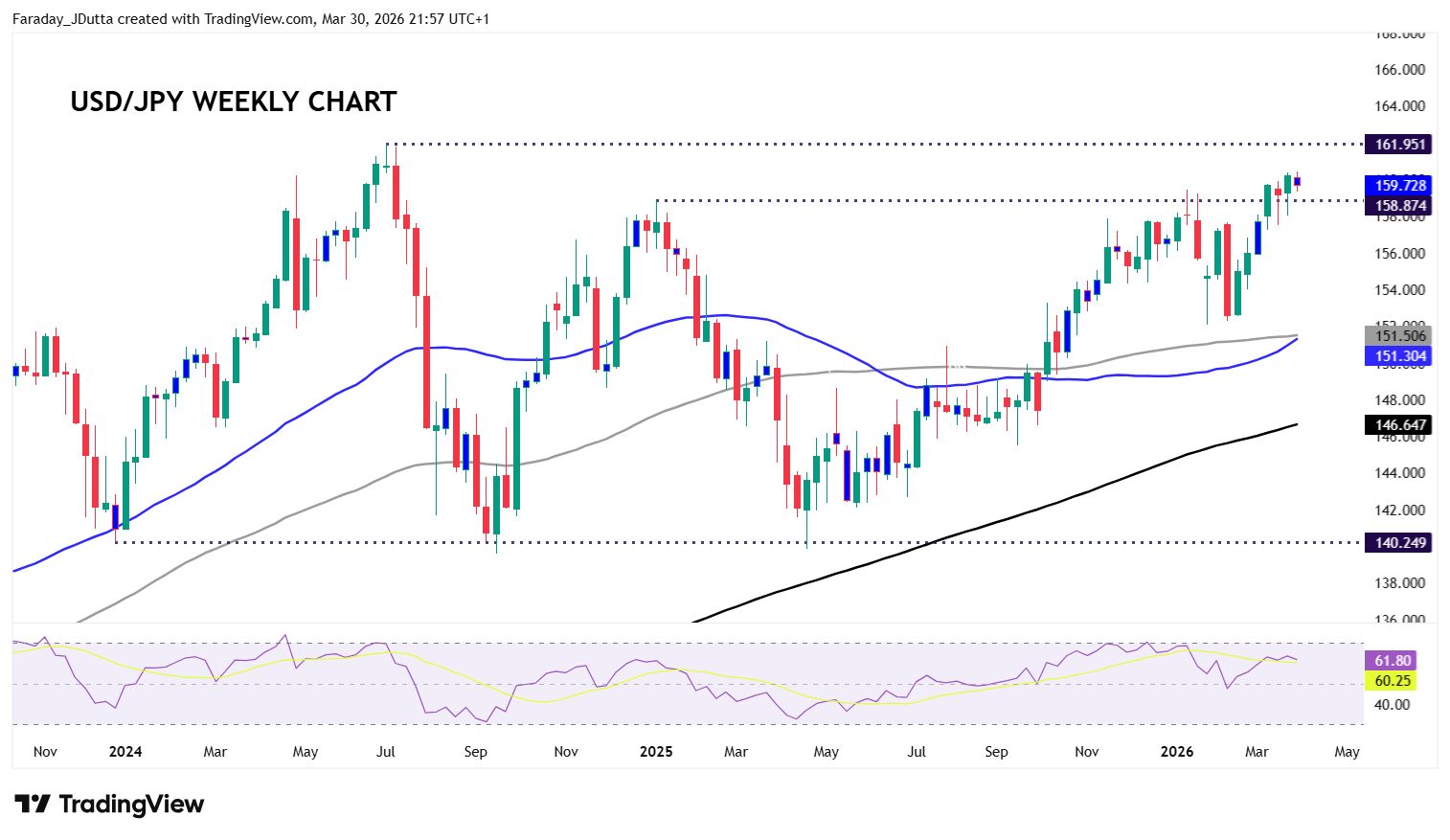
Chart of the Day – USD/JPY into intervention zone
USD/JPY kicked off the week making new cycle highs above 160, that is an unofficial intervention zone for the MoF. Officials said they were watching market moves with an “extremely high sense of urgency”. As we said in the Week Ahead, will Washington be happy with Japan selling up to $100bn (as it did in 2024) and presumably US Treasuries to finance those FX sales? 10-year US Treasury yields have already risen 50bps in March, and large-scale Japanese FX intervention could worsen the Treasury sell-off. We also got the release of the latest BoJ minutes which were rather hawkish. There were several references to monetary policy ‘falling behind the curve’ and being way below neutral. There was also even some debate over the size of forthcoming rate hikes. Is a 50bps move at the next meeting on April 28 possible?