


 Updated
A bull flag is one of the most recognisable bullish continuation patterns in technical analysis.
It forms after a strong upward move (the flagpole) followed by a brief, orderly pullback (the flag) before price potentially breaks higher. Traders often study the bull flag chart pattern to identify moments when momentum may temporarily pause before resuming in the direction of the existing trend.
The key idea is that the bull flag represents a pause, not a key reversal. Buyers push the price sharply higher, the market temporarily consolidates, and if momentum returns, the uptrend may continue.
You’ll find the bull flag continuation pattern across many markets—including forex, commodities, and stocks—and it can appear on any timeframe. The structure is often analysed using a candlestick chart, hence it’s also referred to as the bull flag candlestick pattern.
What Is a Bull Flag Pattern?
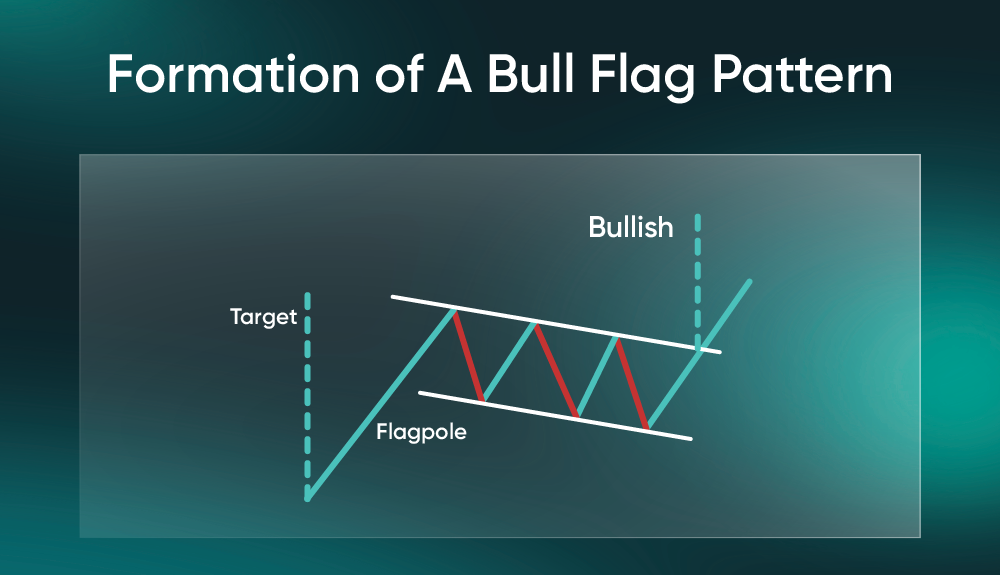
A bull flag is a bullish continuation pattern that forms when a strong upward price movement briefly pauses before potentially continuing higher.
Here is the bull flag pattern explained:
- Flagpole: A steep, impulsive rally driven by strong buying pressure.
- Consolidation: Otherwise known as the ‘flag’, it’s typically portrayed as a short pullback or sideways channel that slopes slightly downward, and should not be lower than 50% of the prior uptrend.
- Breakout: The price moves above the consolidation zone, indicating the bull flag breakout pattern.
- Target Projection: This is the height of the flagpole added to the breakout point to estimate where the move may potentially extend.
The bull flag continuation pattern shows that although price temporarily consolidates, buyers remain in control. A breakout above the flag’s upper boundary is commonly discussed in technical analysis as a potential continuation structure, although outcomes can vary in practice.
Related Article: A Complete Guide to Supply and Demand: How to Use It
Bull Flag vs. Bear Flag: What’s the Difference?
While a bull flag signals potential continuation to the upside, its inverse—i.e., the bear flag—suggests possible continuation to the downside.
| Feature | Bull Flag | Bear Flag |
| Direction of Prior Move | Strong upward rally | Strong downward drop |
| Consolidation Angle | Slightly downward or sideways | Slightly upward or sideways |
| Breakout Direction | Upward | Downward |
| Market Implication | Possible trend continuation higher | Possible trend continuation lower |
The comparison highlights that both patterns share the same structural logic—a sharp move, a controlled pause, and a breakout—but in opposite directions.
Anatomy of the Bull Flag Chart Pattern
A bull flag candle pattern is more than a visual formation.
It reflects a moment where strong bullish momentum pauses, resets, and potentially resumes. Understanding why the structure forms is just as important as recognising how it looks on a bull flag pattern chart.
This pattern typically develops after buyers drive the price sharply higher. Instead of reversing, the market pauses in a tight consolidation, showing that selling pressure is limited and that buyers may still be in control.
When price eventually breaks out of this consolidation, the bull flag breakout pattern signals a potential continuation of the existing trend.
5 Key Characteristics of the Bull Flag Pattern
Here are some of the key structural traits traders look for when identifying a bull flag, along with the psychology behind them:
1. A Strong Flagpole
What It Is: A steep, fast rally that creates the foundation of the pattern.
Psychology: Buyers are in control, sentiment is strong, and momentum builds quickly as traders fear missing out on the move.
2. A Controlled Pullback (the Flag)
What It Is: Price drifts slightly downwards in a tight range.
Psychology: Early buyers take profits, but selling pressure is limited. The market pauses without showing signs of reversal.
3. Parallel or Converging Trendlines
What It Is: Depending on the variation, the consolidation becomes either a rectangular flag (parallel channel) or a triangular (pennant) flag—more on that in later sections.
Psychology: The market is balancing, whereby lower volatility and shrinking ranges show that both sides are waiting for new information and the crowd is undecided in the short term.
4. Volume Declines During the Flag
What It Is: Trading activity tends to soften as the flag develops.
Psychology: Momentum cools, but accumulation often quietly continues. A decline in volume shows that the pullback is not driven by strong selling.
5. Breakout Supported by Rising Volume
What It Is: Price pushes above the flag’s resistance line, ideally with a volume increase.
Psychology: Fresh buyers re-enter, early shorts exit, and the previous trend regains control.
Related Article: The Basics of Support & Resistance
Bull Flag Pattern Examples: 3 Variations Traders Need to Know
In technical education, instructors often highlight that bull flag patterns can appear in different variations.
The underlying psychology remains the same, but the shape of the consolidation can differ based on volatility and market conditions.
Here are the three most common variations:
1. Rectangular Bull Flag
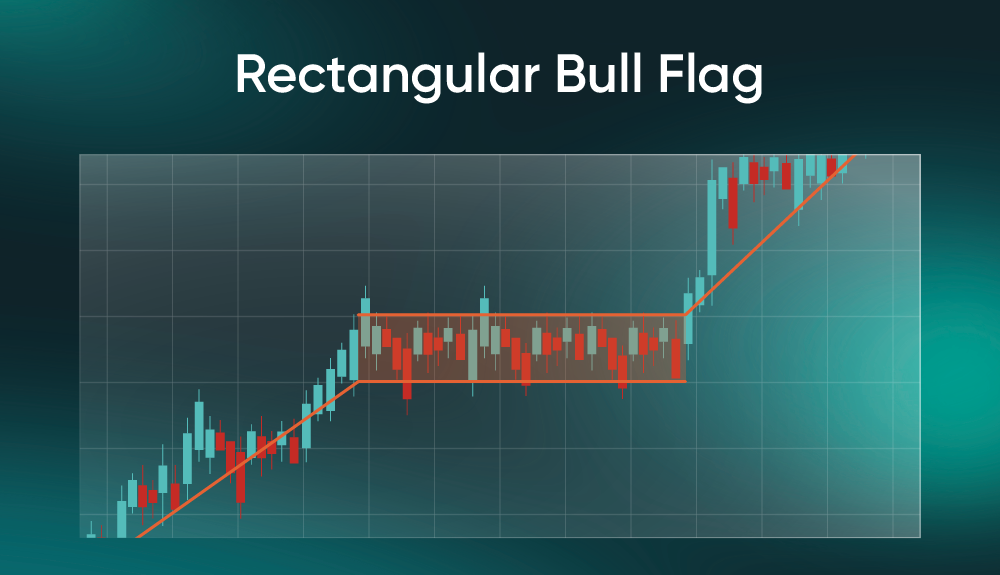
Structure: A small, downward-sloping channel with parallel upper and lower boundaries.
Psychology: The market is digesting the prior rally in an orderly fashion. Sellers are present but not dominant, creating a mild, controlled retracement.
2. Triangular Bull Flag (Bullish Pennant)
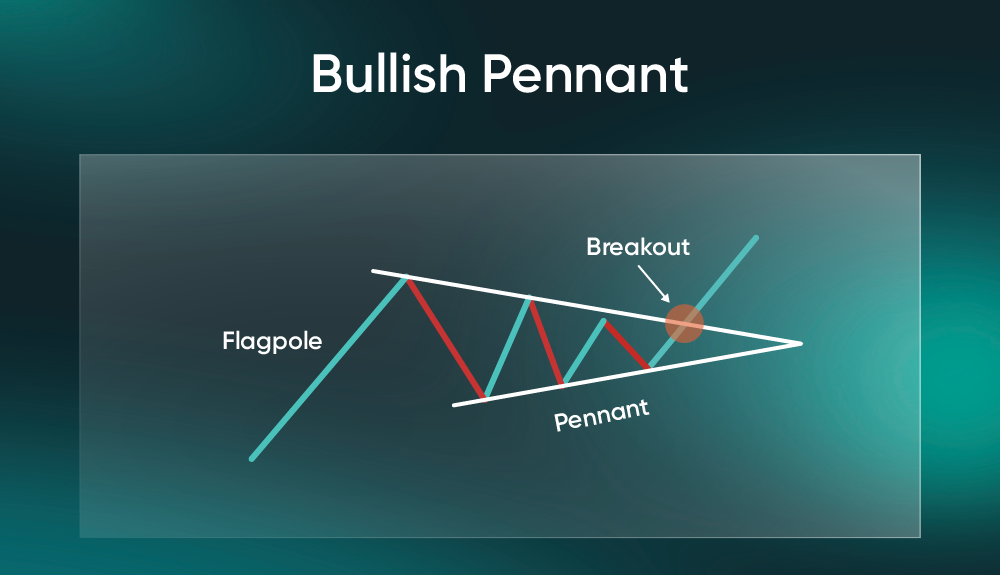
Structure: Converging trendlines forming a small symmetrical triangle, otherwise known as a pennant.
Psychology: Volatility compresses as traders await a catalyst. This often precedes sharp bull flag breakout patterns because energy builds within a narrowing price range.
3. High and Tight Bull Flag

Structure: A steeper and more aggressive variant where the flagpole is unusually vertical due to a dramatic price surge (around 50% to 100%) and the flag is extremely shallow, with a brief retracement of typically 10–20%.
Psychology: Demand is so strong that sellers barely manage a pullback. The high and tight flag can appear in fast-moving markets like stocks but may be riskier due to the speed of the advance.
[H3] Using a Screener to Find Bull Flags Efficiently
Manually scanning charts can be time-consuming.
A practical approach is to use a market scanner or screener that filters instruments based on trend strength, volatility compression, or breakout conditions.
On Vantage ProTrader, users can explore built-in screeners to learn how patterns like bull flags may be visually represented on charts. These tools can help users:
- Observe conditions where bull flag-like structures may appear,
- View how trend direction filters organise chart data,
- See how price consolidation areas are displayed, and
- Understand how potential breakout conditions are illustrated within the interface
This helps demonstrate how such patterns may be presented across forex, commodities, and global stocks.
Related Article: 6 Forex Trading Strategies for Beginners
Valuable Insights on the Bull Flag
Besides interpreting the structural and psychological traits of the different bull flag chart patterns, here are some key insights for traders to make more informed decisions in the markets:
Timeframe
Bull flags can appear on any timeframe, from one-minute charts to weekly charts, but their reliability often improves as the timeframe increases. On lower timeframes, price movements tend to be noisier, and sharp intraday volatility can distort the structure.
Bull flag pattern timeframes typically include:
- Intraday Charts: Anywhere from 15 minutes to several hours
- Daily Charts: 3 days to 3 weeks, depending on volatility
- Weekly Charts: Multiple weeks or even months, especially in strong trending markets
What matters is not the absolute duration, but that the flag forms as a controlled pause in the trend. A flag that drags on too long may lose its continuation potential, while one that is too short may signal a shallow pullback rather than a meaningful consolidation.
The key is that the market shows temporary equilibrium—a brief period where buyers pause, sellers test the downside, and neither side overwhelms the other. When buyers reassert control, the pattern usually breaks out.
Interpreting the Slope
The slope of the consolidation tells an important story about market psychology:
1. Slight Downward Slope (Most Common)
A gentle downward channel is the classic bull flag candle pattern.
This slope reflects:
- Profit-taking from early buyers
- A controlled, orderly pullback
- Sellers testing momentum but failing to reverse the trend
Many traders perceive the slight downward slope as the most structurally healthy variation of the bull flag chart pattern.
2. Sideways Slope (Neutral Flag)
Some bull flags also consolidate horizontally, forming a tight band.
This reflects:
- Balanced buying and selling
- Strong underlying trend momentum
- A market waiting for new information before committing
Sideways flags often precede sharp breakouts because energy is compressed within the range.
How Accurate Are Bull Flags?
The bull flag chart pattern can be a useful continuation structure. But like all technical patterns, its reliability depends on market context, trend strength, liquidity, and how well the formation develops.
As such, traders should view the bull flag pattern as an analytical tool best used with other complementary technical indicators and proper risk management.
4 Advantages of the Bull Flag Chart Pattern
When assessed correctly and used alongside broader market analysis, the bull flag pattern can offer several practical benefits. These advantages help traders understand why the structure is widely recognised in technical analysis, especially during strong trending conditions.
1. Clear Trend Continuation Structure
Bull flags can appear after a strong, impulsive advance. This structure is frequently referenced in educational materials for illustrating trend continuation concepts.
This candlestick pattern can thus help visualise where buyers may be regrouping after an initial push.
2. Defined Entry and Risk Areas
The chart pattern naturally creates a breakout level (the top of the flag) and a logical risk zone (just below the flag’s lower boundary). This can help clarify how technical analysts map hypothetical risk and reward zones in a theoretical learning context.
3. Works Across Markets
The bull flag pattern in stocks, commodities, forex, and indices follows the same structural logic: Strong move → pause → breakout.
This continuation pattern is referenced across different asset classes in technical literature because the visual formation can appear in various markets.
4. Volume Can Add Context
While not an absolute requirement, increasing bull flag pattern volume during the breakout can help validate that buyers are stepping back in after consolidation.
This can help add confidence in environments where liquidity is stable.
4 Risks of the Bull Flag Chart Pattern
Despite its strengths, the bull flag pattern is not foolproof. Market volatility, weak participation, or structural imperfections can reduce its reliability.
Understanding these limitations helps readers interpret the bull flag pattern more realistically in an educational setting.
1. False Breakouts
The most common risk is a false breakout, where price moves above the flag briefly but lacks the follow-through to sustain the trend.
This can happen during low-liquidity periods, news-driven volatility, or when momentum is fading.
2. Pattern Misidentification
Not every pullback after a rally is a certified bull flag.
Overly deep retracements, wide or erratic consolidation, or sharp V-shaped reactions can create lookalikes that do not behave like true continuation patterns.
3. Timeframe Distortion
On lower timeframes, price action is more prone to noise. This can make the bull flag breakout pattern less reliable, as micro-volatility may distort structure or trigger premature entries.
4. Market Conditions Matter
Choppy or directionless environments often fail to support continuation.
The pattern is less effective when:
- Liquidity is thin
- Volatility is unusually high
- Broader market sentiment contradicts the prior trend
Even a well-formed bull flag can fail if the larger environment shifts suddenly.
Look Out for These Warning Signs of Bull Flag Failures
Certain behaviours within the price structure can signal that a bull flag pattern is weakening or at risk of failing. These warning signs can help traders differentiate between healthy consolidations and patterns that may not follow through.
1. Deep or Extended Consolidation
Flag retracements that dig too far into the flagpole (typically more than 50%)—or consolidation that lasts disproportionately long—often signal fading trend strength rather than a healthy pause characteristic of this chart pattern.
2. Breakout With Weak Participation
A breakout on noticeably weak volume (in liquid markets) or low volatility may reflect hesitation among buyers. This could increase the probability of a quick reversal or range re-entry.
3. Failure to Hold Above Breakout Level
If price breaks out but cannot stay above the flag’s upper boundary—especially after a retest—the chart pattern may lose validity.
Repeated failed attempts to clear resistance often indicate a shift in control from buyers to sellers.
4. Broader Trend Weakness
If the bull flag forms late in an extended trend or during a period of weakening momentum, the continuation thesis becomes less reliable.
Divergences in momentum indicators or slowing volatility regimes can be early clues.
Using a Bull Flag Pattern: A Step-by-Step Guide
Using the bull flag candlestick pattern effectively involves more than spotting the shape on a chart.
Traders typically build a structured process around entry timing, target setting, exit planning, and confirming the setup with other technical tools. The goal is not to predict outcomes with certainty, but to approach the pattern in a consistent, risk-managed way.
1. Prepare an Entry Checklist
In educational settings, market analysts often review whether the structure meets commonly referenced bull flag characteristics:
- Strong Flagpole: A clear upward move with expanding volume.
- Orderly Consolidation: A tight downward-sloping or sideways channel with controlled pullbacks.
- Well-Defined Resistance: An upper boundary for the flag where the breakout level becomes obvious.
- Volume Context: Often lighter during consolidation and stronger on the breakout, signalling increased participation from buyers.
- Timeframe Alignment: Bull flags tend to show up more clearly on higher time frames, where noise is reduced.
Once the structure meets key bull flag criteria, examples of potential entry approaches include:
- Illustrative Aggressive Entry: Hypothetical purchase if the price breaks the flag’s upper trendline.
- Illustrative Conservative Entry: Hypothetical waiting for a breakout above resistance and a possible retest.
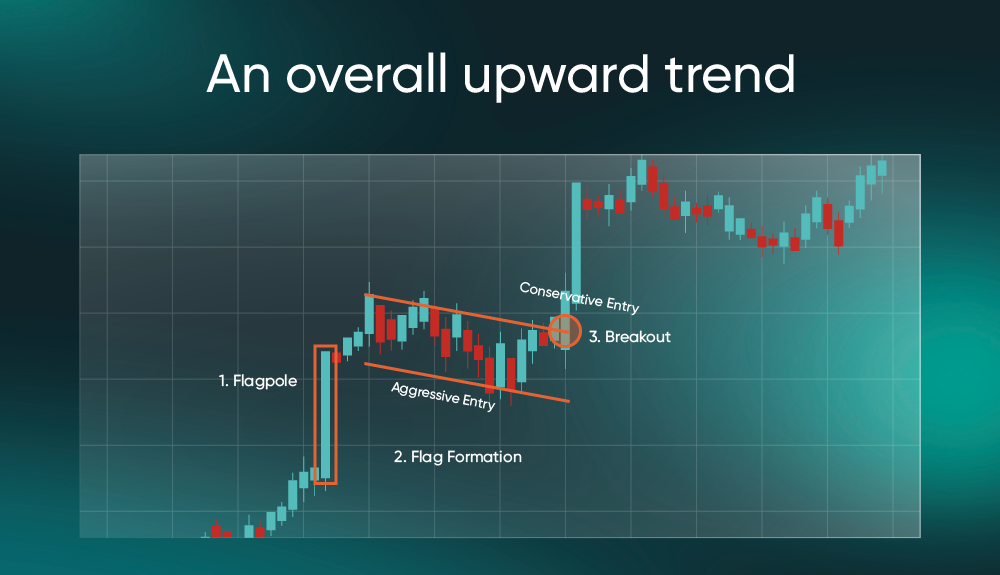
Take note that these examples are provided for educational purposes only and are not trading recommendations.
2. Set Target Price
In educational charting examples, some instructors demonstrate how target projections are calculated for illustration only. A common educational method to illustrate a bull flag pattern involves measuring the flagpole height and projecting it above the breakout point.
This projected target zone is purely hypothetical and does not predict future price movements or serve as trading advice.
Depending on the time frame and prevailing market conditions, traders may:
- Scale out of positions at partial levels
- Use multiple target tiers
- Extend targets in strong momentum environments
- Reduce targets during slower market phases
Take note that targets are guides, not guarantees, and should be considered alongside broader market context.
3. Plan an Exit Strategy
Exit planning is essential, especially in fast breakouts. Educational examples of exit approaches often discussed in technical analysis include:
- Hypothetical Stop-Loss: Placing a stop below the consolidation low as an illustrative concept.
- Illustrative Trailing Stops: Showing how positions might be adjusted to manage risk.
- Theoretical Partial Profit-Taking: Demonstrating risk management techniques.
- Time-Based Exits: Used in theory to close positions within a session.
A well-defined exit can help reduce emotional decisions, especially when the price accelerates quickly after the breakout.
These risk-management concepts are regularly shown in educational examples to illustrate how technical analysis theoretically map exits. Bear in mind that these are not recommendations and may not be suitable for real market conditions.
4. Pair With Other Technical Analysis Tools
Combining the bull flag pattern with additional analytical tools can help filter setups:
- Moving Averages: To confirm the prevailing trend
- Momentum Indicators (e.g., RSI, MACD): To identify strength or divergence
- Volume Profile: To understand where participation is concentrated
- Support/Resistance Mapping: To check that the breakout is not heading directly into a strong ceiling
- Multiple Timeframe Analysis: To confirm that the flag aligns with broader trend behaviour
Integrating the bull flag with other forms of analysis doesn’t guarantee outcomes, but it can offer a more complete view and reduce reliance on a single chart pattern.
Mastering the Bull Flag Pattern
Learning to read the bull flag goes beyond spotting shapes.
It involves interpreting the psychology behind the pullback, assessing the quality of the trend, and using a checklist that includes structure, breakout level, timeframe, and broader market context.
While no pattern is flawless, the bull flag can help traders identify continuation opportunities across markets—from forex to commodities, indices to stocks—especially during strong trending environments.
When combined with risk management, realistic targets, and complementary tools such as support-resistance mapping or momentum indicators, the pattern becomes a useful part of a trader’s analytical framework.
If you’d like to explore these concepts further, you can review charts using Vantage’s Live Account or practise identifying chart patterns with a Demo Account now.