




When people start trading, they often choose between index trading and stock trading.
Index trading involves investing in a market index, such as the S&P 500 or the Nasdaq 100, which comprises a group of companies. What is an index in trading? Think of an index as a “basket” of top companies. When you invest in it, you’re buying a small part of many businesses at once. This helps spread risk and follow the overall market’s growth, making it simpler and less hands-on.
Stock trading is when you pick and trade individual company stocks yourself. It is riskier and takes more research and effort, but you have a chance to earn more if you choose the right stocks.
Let’s look at Tesla, which is part of the S&P 500, to see how these two styles of trading can differ in practice.
Key Points
- Index trading provides broad market exposure, fostering stability and long-term growth through diversification.
- Stock trading demands detailed analysis for higher potential returns, yet carries greater risk and volatility.
- Tesla’s fluctuating performance versus the S&P 500’s resilience showcases diversification’s role in risk management, emphasising the robustness of index trading over stock trading.
Understanding Index Trading and Stock Trading
Index Trading
Index trading is an easy way to take part in the markets by trading a stock market index such as the S&P 500.
Here’s how you can trade indices:
- Exchange-Traded Funds (ETFs) and Mutual Funds: These funds mirror the performance of a specific market index.
- Contracts for Difference (CFDs): CFDs let you speculate on price movements of an index without owning the underlying stocks.
Why trade stock indices?
It is simple. It is cost-effective.
You gain exposure to the broader market and capture the performance of multiple companies in a single trade.
No meticulous stock selection. No market timing.
Just ride along with the long-term rise of the market.
Interested in stock index trading? Open a live account with Vantage today and start trading index CFDs with ease.
Stock Trading
In contrast, trading stocks is an active trading strategy that focuses on analysing and selecting individual stocks to outperform the broader market, which may offer potentially higher returns.
But here’s the catch — it’s not as simple as it sounds.
This method requires a deep understanding of market trends, industry performance, and company fundamentals. It comes with greater risks and demands more time, research, and discipline to execute successfully.
Case Study Analysis – Tesla in the S&P 500
Now, let’s compare index vs stock trading in the case of Tesla. We’ll compare the results of investing solely in Tesla stock to investing in the broader market index, the S&P 500, which includes Tesla among its components.
Investing in Tesla Stocks
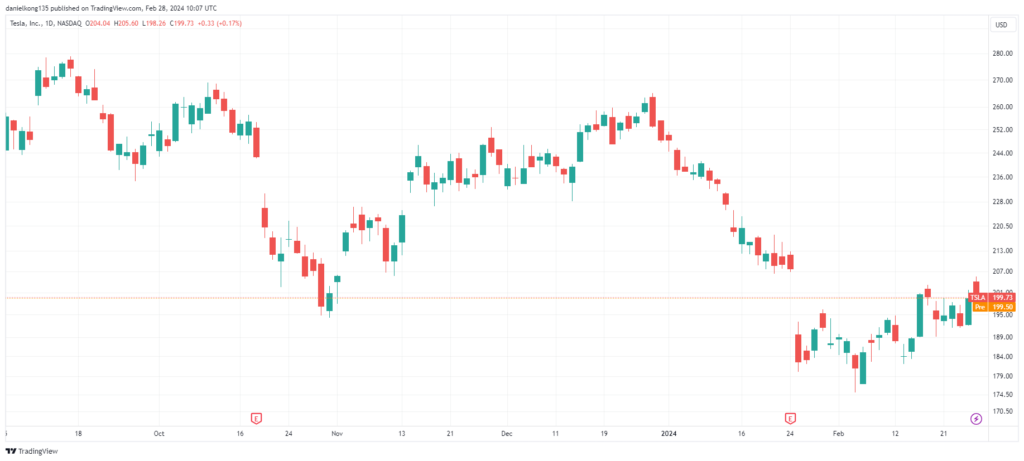
October 2023 – Upward trend
Tesla‘s stock climbed to $263.62 on 10 October 2023, reflecting investor confidence in the company’s growth potential, regulatory developments, and technological progress.
January 2024 – Major Decline
By 25 January 2024, Tesla’s stock saw a sharp 12% drop, its biggest decline in over a year [1]. The fall followed a disappointing earnings report and a warning of slower growth in 2024 as Tesla shifted focus to developing its ‘next-generation vehicle’.
Notably, Tesla’s automotive revenue for the fourth quarter of 2023 was $21.6 billion, marking a modest increase of 1% from the previous year [2].
February 2024 – Sideways Trading
In February 2024, Tesla’s stock price fluctuated between $180 and $200 before closing at $202.04 on 28 February 2024.
| Stock Price on Closing 2 October 2023 | Stock Price on Closing 28 February 2024 | % Changes | Profit or Loss | |
| 1 unit of Tesla stock | $251.60 | $202.04 | – 19.67 | – $49.56 |
What does this mean for the stock traders of Tesla?
If you had bought 1 stock of Tesla in October 2023, your position would have seen a loss of $49.56 by the end of February 2024.
Investing in the S&P 500 Market Index
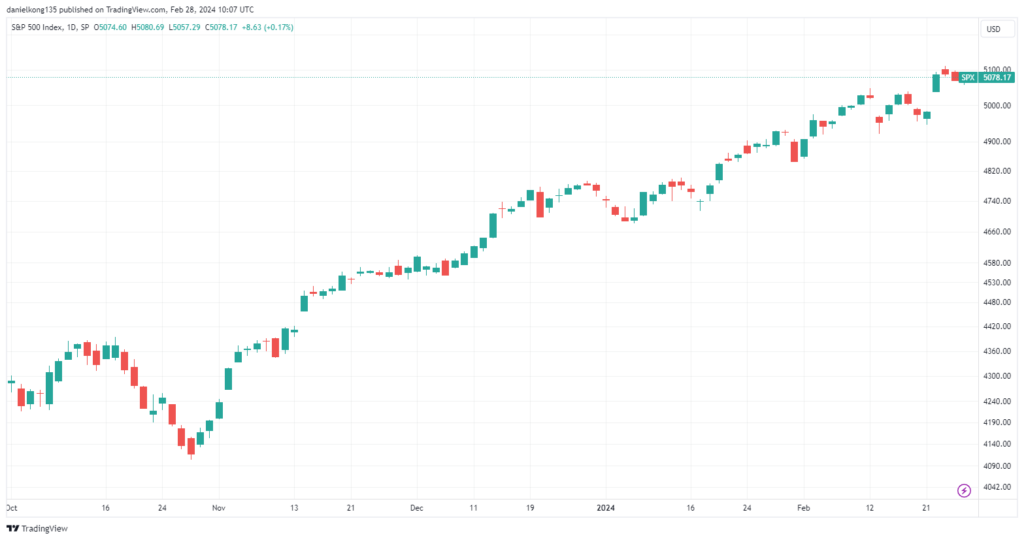
October 2023 – Steady Start for the S&P 500
The S&P 500 index, which represents the top 500 U.S. companies by market capitalisation, was trading at $4,288.39 on 2 October 2023. It trended slightly downward through October before gaining an upward momentum in November.
February 2024 – S&P 500 Breakthrough
By 8 February 2024, the S&P 500 broke past the 5,000 mark for the first time in history — a milestone moment despite ongoing economic uncertainty and geopolitical tension in 2023[3].
What drove the rally?
A major catalyst was the surge in demand for artificial intelligence, driven by Nvidia, a tech leader known for its cutting-edge GPUs for gaming and professional use. It is a key component of the S&P 500 index. Following its earnings announcement, Nvidia’s stock jumped from $674.72 to $785.38 on 22 February 2024.
The result?
The S&P 500 hit another record high, closing at 5,087.03, gaining 105.23 points (2.11%) [4].
| Stock Price on Closing 2 October 2023 | Stock Price on Closing 28 February 2024 | % Changes | Profit or Loss | |
| 1 unit of S&P 500 index | $4,288.39 | $5,069.76 | 18.22 | $781.37 |
If you had bought 1 unit of the S&P 500 index using CFDs at the start of October 2023, you would have seen a potential profit of $781.37.
This highlights an important point — while individual stocks like Tesla can decline sharply over a period, trading an index like the S&P 500 often shows more stability. In the case of the S&P 500, the decline in Tesla’s price was significantly mitigated by Nvidia’s gains. It’s important to note that as of the date of writing, Tesla makes up only 1.29% of the S&P 500 index, whereas Nvidia accounts for 4.58% of the index [5].
You might think, “Why not just invest in Nvidia since it’s been performing so well?”
It’s true. Nvidia’s gains have been impressive.
But the reality is, predicting which company will be the next big winner is difficult. The same stock that’s soaring today could face a decline tomorrow, just like Tesla did.
That’s why index trading is often seen as a more balanced, lower-risk approach. Instead of relying on the success of a single company, you benefit from the performance of many — balancing risk while still capturing market growth.
Index vs Stock Trading: Risk or Reward?
The debate between index trading and stock trading always comes down to one question: risk or reward?
Trading an individual stock like Tesla could bring high returns. If the company’s value skyrockets, so can your returns.
Sounds exciting, right?
But with high reward comes high risk. A single earnings miss, regulatory shift, or market shock can send prices tumbling overnight.
Now, what about index trading?
This approach takes the opposite route — it’s all about balance and consistency. By investing in an index, you’re spreading your risk across hundreds of companies. That means one stock’s losses can be cushioned by gains elsewhere. The returns may not be as dramatic, but they’re often more stable over time.
Diversification is your built-in safety net. It helps cushion your portfolio from the shocks of market volatility and reduces the impact of any single company’s performance. In short, while stock trading is like sprinting for quick wins, index trading is a marathon built for steady growth.
Conclusion
The difference between index trading and stock trading comes down to risk and potential returns.
When you trade individual stocks, such as Tesla, you can earn big returns, but you also face increased volatility owing to shifting stock performance.
In contrast, index trading offers a more balanced way to invest. When you trade an index such as the S&P 500, your investment is spread across hundreds of companies. This diversification helps reduce risk — if one stock falls, others in the index can help balance it out. The S&P 500 index, for example, has remained strong even when individual stocks like Tesla have declined.
Choosing between stock trading and index trading depends on your risk tolerance and goals. If you prefer more stability, trading an index like the S&P 500 may be the better choice.
Ready to get started?
Open a live account with Vantage today to trade stock CFDs and indices CFDs with flexibility and precision. Our platform lets you go long to benefit from rising markets or short sell to take advantage of market downturns, giving you flexibility in your trading strategy.
References
- “Tesla erases $80 bln in valuation after Musk’s sales warning – Reuters”. https://www.reuters.com/business/autos-transportation/tesla-tumbles-after-ceo-elon-musk-warns-slower-growth-2024-2024-01-25/. Accessed 28 Feb 2024.
- “Tesla shares close down 12% after automaker warns of slowdown – CNBC”. https://www.cnbc.com/2024/01/25/tesla-tsla-shares-fall-after-musks-ev-maker-warns-of-2024-slowdown.html. Accessed 28 Feb 2024 .
- “S&P 500″ Breaks 5,000 For First Time In History – Forbes”. https://www.forbes.com/sites/dereksaul/2024/02/08/sp-500-breaks-5000-for-first-time-in-history/?sh=e09397273613. Accessed 28 Feb 2024.
- “S&P 500, Dow surge to record closing highs as Nvidia sparks AI frenzy – Reuters”. https://www.reuters.com/markets/us/nasdaq-futures-jump-nearly-2-after-nvidia-trounces-expectations-2024-02-22/. Accessed 29 Feb 2024.
- “S&P 500 ETF Components – Slickcharts”. https://www.slickcharts.com/sp500. Accessed 29 Feb 2024.