



 Updated
The commodity market operates from 9:00 AM to 11:30 PM IST (Monday to Friday), extending until 11:55 PM during months when US daylight saving is inactive. Unlike the equity market, which closes at 3:30 PM IST, commodity trading on the Multi Commodity Exchange of India (MCX) runs across two sessions to align with both domestic activity and major global commodity markets.
Understanding commodity market timing matters whether you are trading gold, silver, crude oil, or agricultural products. The timing of your entry or exit can affect trade execution, liquidity, and your exposure to overnight price gaps. This guide covers MCX trading hours, session breakdowns, commodity-specific timings, the 2026 holiday calendar, and commonly observed periods of market activity and liquidity.
Key Points
- MCX trading generally runs from 9:00 AM to 11:30 PM IST, Monday to Friday, with the closing time extending to 11:55 PM during certain months.
- Trading is divided into two main sessions: a morning session (9:00 AM to 5:00 PM IST) and an evening session (5:00 PM to 11:30 PM or 11:55 PM IST), with a 14-minute pre-market session from 8:45 AM to 8:59 AM.
- Agricultural commodities close at 5:00 PM IST, while non-agricultural commodities such as gold, crude oil, and copper continue trading until 11:30 PM or 11:55 PM IST depending on the season.
What is the Commodity Market Timing for MCX?
The Multi Commodity Exchange (MCX), is the country’s largest commodity derivatives exchange by trading volume, offering contracts across metals, bullion, energy, and agricultural products. The commodity market operates Monday to Friday and remains closed on weekends and public holidays declared by MCX.
The commodity market timing is significantly longer than the equity market’s trading window. This is because MCX aligns its evening session with the opening hours of US commodity markets — particularly the New York Mercantile Exchange (NYMEX) and the Chicago Mercantile Exchange (CME) — allowing traders to react to global price movements in real time.
The table below summarises the standard MCX trading schedule:
| Session | Timing (IST) | Days |
| Pre-Market | 8:45 AM – 8:59 AM | Monday–Friday |
| Morning Session | 9:00 AM – 5:00 PM | Monday–Friday |
| Evening Session (Summer / US DST active) | 5:00 PM – 11:30 PM | Monday–Friday |
| Evening Session (Winter / US DST inactive) | 5:00 PM – 11:55 PM | Monday–Friday |

MCX Trading Hours and Sessions
MCX’s trading day is structured into three distinct phases. Understanding each phase helps traders plan their activity, manage pending orders, and avoid placing trades outside active market hours.
Pre-Market Session (8:45 AM – 8:59 AM IST)
A 14-minute pre-market session runs before regular trading begins each day, from 8:45 AM to 8:59 AM IST. During this window, traders can review, modify, or cancel pending orders from the previous session, but cannot enter new positions. The session allows participants to adjust strategies based on overnight global developments — such as US market closes or major commodity price shifts — before the main session opens at 9:00 AM.
Morning Session (9:00 AM – 5:00 PM IST)
The morning session opens at 9:00 AM IST and runs until 5:00 PM IST. Agricultural commodities — including chana, castor seed, cotton, and paddy — are only available during this session and close at 5:00 PM. International benchmarks such as gold and crude oil also trade during the morning session, continuing into the evening. Liquidity and trading volumes are typically highest in the first hour after market open (9:00 AM–11:00 AM IST), when domestic institutional activity is at its peak.
Evening Session (5:00 PM – 11:30 PM / 11:55 PM IST)
The evening session is the most active period for non-agricultural commodities, including metals (gold, silver, copper) and energy products (crude oil, natural gas). This session overlaps with European and US commodity market hours, which typically produces the day’s highest volatility and liquidity windows for globally-priced instruments.
Evening session closing times vary based on US daylight saving time (DST). During summer months when US DST is active, the session closes at 11:30 PM IST. During winter months when US DST is inactive, the session extends to 11:55 PM IST. This adjustment ensures MCX’s evening session consistently aligns with the close of US commodity exchanges regardless of seasonal time differences.
Commodity Market Timing by Category
Different commodity categories on MCX follow different closing times, even though all trading begins at 9:00 AM IST. The distinction exists because agricultural commodities follow domestic supply-and-demand cycles and close with the standard session, while non-agricultural commodities such as gold and crude oil are globally priced and require extended hours to capture US market price discovery.
| Commodity Category | Opening Time (IST) | Closing Time (IST) |
| Regular Agricultural Commodities | 9:00 AM | 5:00 PM |
| Internationally Referenced Agricultural Commodities | 9:00 AM | 9:00 PM / 9:30 PM |
| Non-Agricultural Commodities (Bullion, Metals, Energy) | 9:00 AM | 11:30 PM (Summer) / 11:55 PM (Winter) |
Note on NCDEX: The National Commodity and Derivatives Exchange (NCDEX) is another major commodity exchange specialising in agricultural derivatives. NCDEX trading hours generally run from 9:00 AM to 5:00 PM IST, Monday to Friday.
MCX Trading Holidays 2026
MCX observes trading holidays on major national and religious occasions each year. Holidays fall into two categories: full holidays, where both the morning and evening sessions are closed, and partial holidays, where only the morning session (9:00 AM–5:00 PM IST) is closed and the evening session operates from 5:00 PM onwards. Additionally, Diwali Laxmi Pujan features a special Muhurat Trading session in the evening.
| Holiday | Date | Day | Sessions Closed |
| Republic Day | 26 Jan 2026 | Monday | Full day |
| Holi | 3 Mar 2026 | Tuesday | Morning only |
| Ram Navami | 26 Mar 2026 | Wednesday | Morning only |
| Mahavir Jayanti | 31 Mar 2026 | Tuesday | Morning only |
| Good Friday | 3 Apr 2026 | Friday | Full day |
| Dr. B.R. Ambedkar Jayanti | 14 Apr 2026 | Tuesday | Morning only |
| Maharashtra Day | 1 May 2026 | Friday | Morning only |
| Mahatma Gandhi Jayanti | 2 Oct 2026 | Friday | Full day |
| Dussehra | TBC* | TBC* | Morning only |
| Diwali – Laxmi Pujan | 8 Nov 2026 | Sunday | Muhurat Trading† |
| Diwali – Balipratipada | 9 Nov 2026 | Monday | Morning only |
| Guru Nanak Jayanti | 28 Nov 2026 | Saturday | Weekend — no impact |
| Christmas | 25 Dec 2026 | Friday | Full day |
Note: several 2026 holidays fall on weekends (Maha Shivaratri on 15 Feb, Id-ul-Fitr on 21 Mar, Independence Day on 15 Aug) and do not create additional weekday trading closures. Always verify the complete holiday calendar on the official MCX website before planning positions around these dates.
What is a Commodity Market?
A commodity market is a financial marketplace where derivative contracts based on raw materials and primary goods are bought and sold. Rather than transacting in the physical goods themselves, traders deal in standardised contracts — typically futures — that represent the right to buy or sell a commodity at a set price on a future date.
Commodities are broadly divided into two categories:
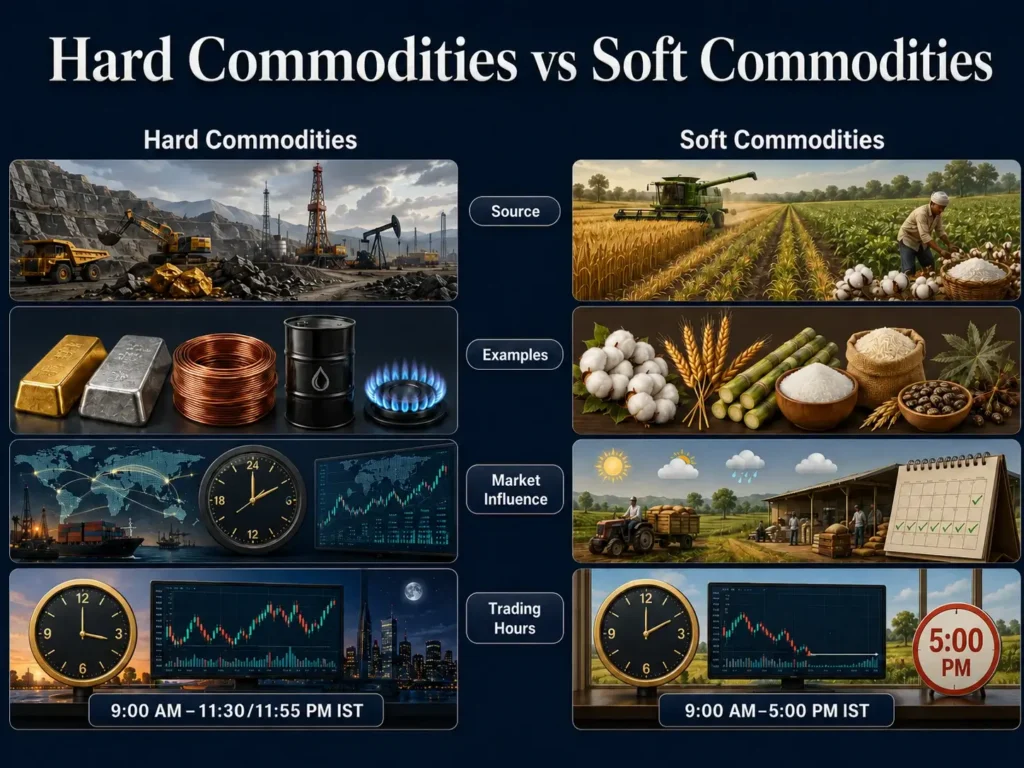
Hard Commodities
Hard commodities are natural resources that require mining or extraction. Examples include gold, silver, copper, lead, nickel, zinc, crude oil, and natural gas. These commodities are globally priced, and their MCX trading hours — particularly in the evening session — are designed to align with US market price discovery on exchanges such as NYMEX and COMEX.
Soft Commodities
Soft commodities are agricultural products that are grown or raised, such as wheat, paddy, sugar, cotton, soya bean, and castor seed. Trading in these products on MCX generally follows the morning session, with most contracts closing at 5:00 PM IST.
The commodity market covers a broad range of agricultural products, including black pepper, cardamom, castor seed, cotton, guar seed, mentha oil, chana, and crude palm oil, alongside bullion, energy, and base metals such as aluminium, copper, and zinc.
Factors Affecting Commodity Market Activity During IST Trading Hours
Commodity market activity does not occur in isolation. Global economic developments, overlapping trading sessions, and other external factors can influence price movements throughout the day. Understanding these factors can help traders identify periods of relatively higher market activity during IST trading hours.
US Daylight Saving Time (DST)
The most direct external factor affecting MCX closing times is US daylight saving time. When the US adjusts its clocks forward (typically March through November), US commodity markets open and close one hour earlier relative to IST. MCX responds by closing its evening session at 11:30 PM IST.
When the US reverts to standard time (November through March), the gap widens and MCX’s evening session extends to 11:55 PM IST. Traders who hold positions through the DST transition dates should account for the one-hour shift in intraday liquidity and session-close timing.
Global Market Overlaps and Best Trading Windows
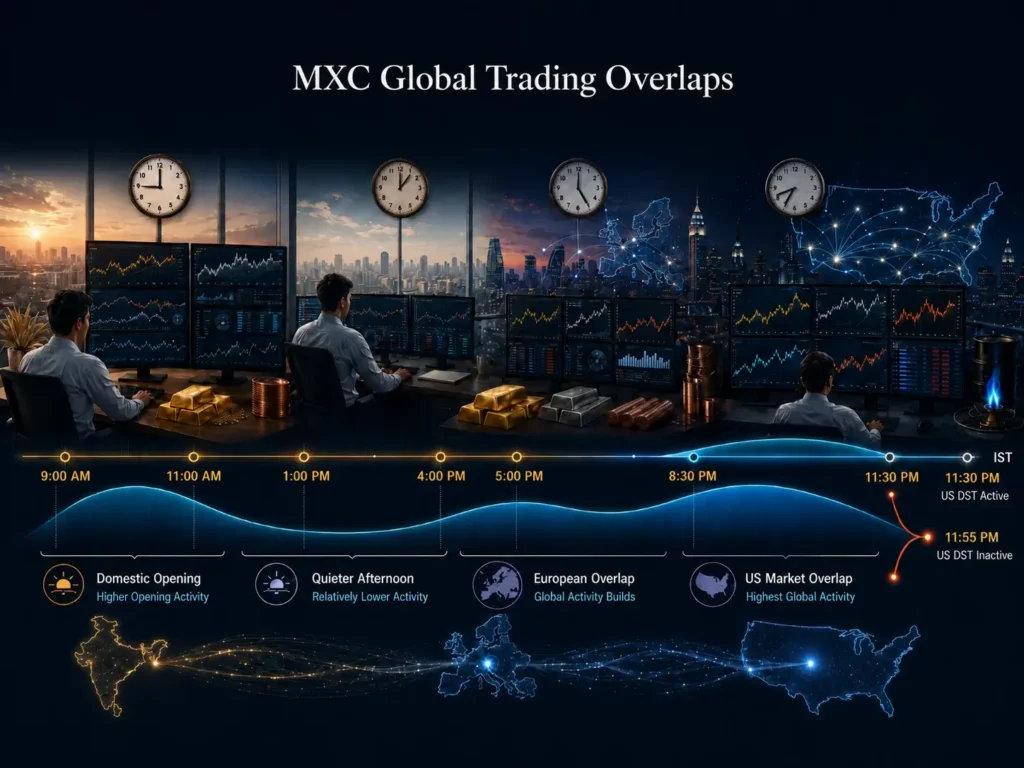
MCX’s extended evening session creates meaningful overlapping windows with European and US commodity exchanges.
For metals and energy, the most active period is the US overlap window — approximately 8:30 PM to 11:30 PM IST — when the CME Group’s NYMEX and COMEX exchanges are fully live, driving price discovery for gold, crude oil, natural gas, copper, and silver.
Major economic data releases during this window, such as the US Energy Information Administration (EIA) weekly crude inventory report and Federal Reserve interest rate decisions, can trigger sharp intraday price movements.
For domestic agricultural commodity traders, the opening hour of the morning session (9:00 AM–11:00 AM IST) typically offers the strongest liquidity, as institutional orders and domestic news flow enter the market.
The early afternoon period (approximately 1:00 PM–4:00 PM IST) tends to be lower-volume for most commodity categories as neither the US session is active nor is there significant domestic news flow, making it a period that most short-term traders avoid.
Ways to Trade Commodities
Commodity trading primarily takes place through derivative markets and spot markets. Most retail traders access commodities through derivative contracts on exchanges such as MCX and NCDEX, which provide structured, regulated trading environments with transparent pricing.
Derivative Markets
The commodity derivative market deals in futures and options contracts. A futures contract is an agreement to buy or sell a specific quantity of a commodity at a specified price on a predetermined settlement date.
Traders use futures to speculate on price movements: taking a long position if they expect prices to rise, or a short position if they expect a decline. Leverage is built into futures contracts, which means both potential gains and losses are magnified relative to the initial margin required.
Traders may also access commodity price movements through Contracts for Difference (CFDs) on international trading platforms. CFDs allow speculation on commodity price changes — such as gold (XAUUSD) or crude oil — without holding an exchange-listed futures contract or taking physical delivery.
CFD instruments may provide exposure to commodity price movements through leveraged derivative products; however, CFDs carry significant risk and may not be suitable for all investors.
Spot Markets
The spot market is where physical commodities are exchanged for immediate delivery at the current market price. Unlike futures contracts, a spot transaction requires the buyer to accept delivery of the physical commodity at the time of settlement.
Spot markets are primarily used by commercial participants — such as manufacturers, agricultural businesses, and commodity processors — to manage physical supply needs rather than for speculative price trading.
Planning Around Commodity Market Hours
Commodity market timing varies by product, session, and seasonal changes in US daylight saving time. While agricultural commodities generally follow shorter daytime hours, bullion, metals, and energy products continue into the evening to overlap with major international markets.
Trading hours may also be adjusted around public holidays, special sessions, or exchange announcements. Traders should therefore confirm the latest schedule directly with MCX or their trading provider before placing or holding positions near a market close.
Regardless of the session, commodity trading involves price risk, and more active periods may bring both greater liquidity and sharper market movements.
Frequently Asked Questions
What time does the commodity market open and close?
MCX, opens at 9:00 AM IST and closes at 11:30 PM IST during summer months (when US DST is active) or at 11:55 PM IST during winter months (when US DST is inactive). The market operates Monday to Friday and remains closed on weekends and declared MCX trading holidays.
What is the MCX trading time for non-agricultural commodities?
Non-agricultural commodities on MCX — including gold, silver, crude oil, natural gas, copper, and zinc — trade from 9:00 AM to 11:30 PM IST during summer months and from 9:00 AM to 11:55 PM IST during winter months. The extended evening session is designed to overlap with US commodity exchange hours, which drive price discovery for globally-traded instruments.
What Is the US Commodity Market Opening Time in IST?
The Chicago Mercantile Exchange (CME) and NYMEX commodity trading sessions typically begin at around 9:00 PM–10:00 PM IST, depending on the US daylight saving schedule. This marks the start of the most active part of the MCX evening session for metals and energy commodities, and is when global price discovery for instruments such as crude oil and gold is most intense.
What is the commodity market timing for crude oil trading?
Crude oil is a non-agricultural commodity and trades on MCX from 9:00 AM to 11:30 PM IST (or 11:55 PM IST during winter months). The highest volatility for crude oil typically occurs between approximately 7:30 PM and 11:30 PM IST, coinciding with the active US crude oil trading window and the weekly EIA crude oil inventory report, which can cause significant intraday price movements.
Is the commodity market open on holidays?
MCX is closed on certain national and religious holidays each year. Some holidays result in full-day closures, where both the morning and evening sessions are suspended. Others are partial holidays where only the morning session is closed and the evening session operates from 5:00 PM onwards. Traders should check the official MCX holiday calendar before opening positions around scheduled holiday dates, as partial closures can affect liquidity during the morning session.
What is the pre-market session in MCX?
The MCX pre-market session runs for 14 minutes from 8:45 AM to 8:59 AM IST each weekday. During this period, traders can review, modify, or cancel pending orders from the previous trading session, but cannot enter new positions. The pre-market session allows participants to respond to overnight global price developments before regular trading begins at 9:00 AM IST.
What is the best time for intraday trading in commodities?
Some intraday commodity traders monitor two commonly observed periods of market activity: the opening hour (9:00 AM–11:00 AM IST) for agricultural and domestically-priced commodities, and the US market overlap window (approximately 8:30 PM–11:30 PM IST) for metals and energy products such as gold, silver, and crude oil. The early afternoon period (around 1:00 PM–4:00 PM IST) typically sees lower trading volumes across most commodity categories and is generally less favourable for short-term trading.
RISK WARNING: CFDs are complex financial instruments and carry a high risk of losing money rapidly due to leverage. You should ensure you fully understand the risks involved and carefully consider whether you can afford to take the high risk of losing your money before trading.
Disclaimer: The information is provided for educational purposes only and doesn’t take into account your personal objectives, financial circumstances, or needs. It does not constitute investment advice. We encourage you to seek independent advice if necessary. The information has not been prepared in accordance with legal requirements designed to promote the independence of investment research. No representation or warranty is given as to the accuracy or completeness of any information contained within. This material may contain historical or past performance figures and should not be relied on. Furthermore estimates, forward-looking statements, and forecasts cannot be guaranteed. The information on this site and the products and services offered are not intended for distribution to any person in any country or jurisdiction where such distribution or use would be contrary to local law or regulation.
References
- “Market Operations: Trade Timings – MCX India” https://www.mcxindia.com/market-operations/trading-survelliance Accessed 22 June 2026
- “Market Holidays – MCX India” https://www.mcxindia.com/ Accessed 22 June 2026
- “Commodity Derivatives Market – SEBI” https://www.sebi.gov.in/ Accessed 22 June 2026