




News trading refers to a strategy where traders make decisions based on the release of news and economic events. This approach is often summed up by the phrase “buy the rumour, sell the news,” which highlights how markets tend to react more strongly to speculation than to the actual outcome of an event.
By looking at how news influences market behaviour, traders aim to anticipate movements and position themselves accordingly. Whether it’s a central bank rate decision, a corporate earnings report, or an unexpected geopolitical announcement, news often sparks volatility that reshapes market sentiment within minutes.
Key Points
- News trading is a strategy that focuses on reacting to economic, political, or corporate events in real time.
- The saying “buy the rumour, sell the news” reflects how anticipation often drives stronger market reactions than the actual release.
- Effective news trading requires awareness of risks, careful analysis, and access to tools like economic calendars and fast execution platforms.
What Is News Trading?
News trading is a strategy where traders base their decisions on economic announcements or major global events. Instead of studying long-term trends, they react to fresh information that can instantly move prices in financial markets. This is why it’s often referred to as trading the news.
A key part of this approach is distinguishing between scheduled news and unscheduled news.
- Scheduled news includes events like central bank meetings, inflation reports, or company earnings releases—traders can prepare for these in advance by following economic calendars.
- Unscheduled news, such as natural disasters, surprise political developments, or sudden corporate announcements, can trigger volatility without warning and requires quick decision-making.
For example, the US Nonfarm Payroll (NFP) report is released on the first Friday of every month and often sparks sharp movements in currency pairs like EUR/USD or GBP/USD. Traders position themselves before the release based on forecasts, but the actual figures can cause immediate swings as markets react to the difference between expectations and reality.
By combining anticipation with fast reactions, a news trading strategy aims to capture opportunities that arise in the immediate aftermath of these events.
What Does Buy the Rumour, Sell the News Mean?
The phrase buy the rumour, sell the news is a long-standing saying in financial markets. It describes the pattern where traders act on speculation about an event before it happens, and then sell once the actual news is released. In practice, this means that anticipation often has a stronger impact on prices than the event itself.
So, what does buy the rumour, sell the news mean in simple terms? Traders typically buy an asset when there are positive expectations—such as a company reporting strong earnings or a central bank announcing a rate cut. When the news finally comes out, even if it matches the forecasts, traders often sell to lock in gains. This selling pressure can cause the price to drop, creating the opposite reaction to what an outsider might expect.
For example, suppose analysts expect the US Federal Reserve to cut interest rates. In the weeks before the decision, speculation may push stock prices and currency markets higher as traders position themselves early. But once the rate cut is officially announced, many of those same traders sell to take profits, leading to a decline even after the “good news.”
Buy the Rumour, Sell the News in Action
The idea of buy the rumour, sell the news shows up frequently across different markets. Traders often describe this pattern in many ways, such as buy on rumour sell on news or sell the news buy the rumour. The meaning is the same: prices often move on anticipation, then reverse once the event is confirmed.
A classic example can be seen during a Federal Reserve rate decision. If traders believe the Fed will lower rates, they may buy stocks and sell the US dollar in advance. Once the cut is officially announced, prices may fall back as traders close their positions. This reaction demonstrates how expectations often outweigh the event itself.
Related Read: Markets at Risk? Understanding the Fallout of Removing Jerome Powell
The same applies to company earnings releases. Share prices sometimes rise in the weeks before results if investors expect strong performance. However, when earnings are announced—even if they meet forecasts—selling pressure can drag the stock lower as early buyers secure their gains.
Geopolitical events can also trigger this behaviour. For instance, rumours of progress in trade negotiations might push a currency higher. Yet when the deal is formally confirmed, the market may reverse because the outcome was already priced in.
A Real-World Example of ‘Buy the Rumour, Sell the News’ — Oracle [1,2]
In September 2025, Oracle delivered what many called a “truly awesome” quarter. A surge in demand for its AI-cloud infrastructure, including several multi-billion-dollar contracts and a leap in its backlog of future committed revenue, surprised Wall Street.
As news of these results spread, Oracle’s shares soared approximately 36% in a single day, marking the steepest jump since 1992. The gain boosted founder Larry Ellison’s net worth dramatically, even briefly placing him past Elon Musk as the world’s richest person.
However, even such dramatic rallies can highlight the principle of ‘Buy the Rumour, Sell the News.’ Much of the buying occurred once the quarterly results were released, as investors reacted to Oracle’s stronger-than-expected AI cloud momentum. Yet, history shows that after such sharp gains, traders who entered early on speculation or rumours may choose to lock in profits, leading to a pullback in the days that follow.
In this way, Oracle’s case illustrates how the excitement surrounding major corporate announcements can fuel short-term surges and create conditions for subsequent selling pressure once the initial euphoria fades.
This illustrates the essence of ‘Buy the Rumour, Sell the News.’
- Before the earnings announcement: Market chatter around Oracle’s AI-cloud momentum and potential large-scale contracts built anticipation among investors.
- After the earnings announcement: While the results stunned Wall Street and triggered an immediate surge in share price, such strong reactions often invite profit-taking, as some participants view the good news as already reflected in valuations.
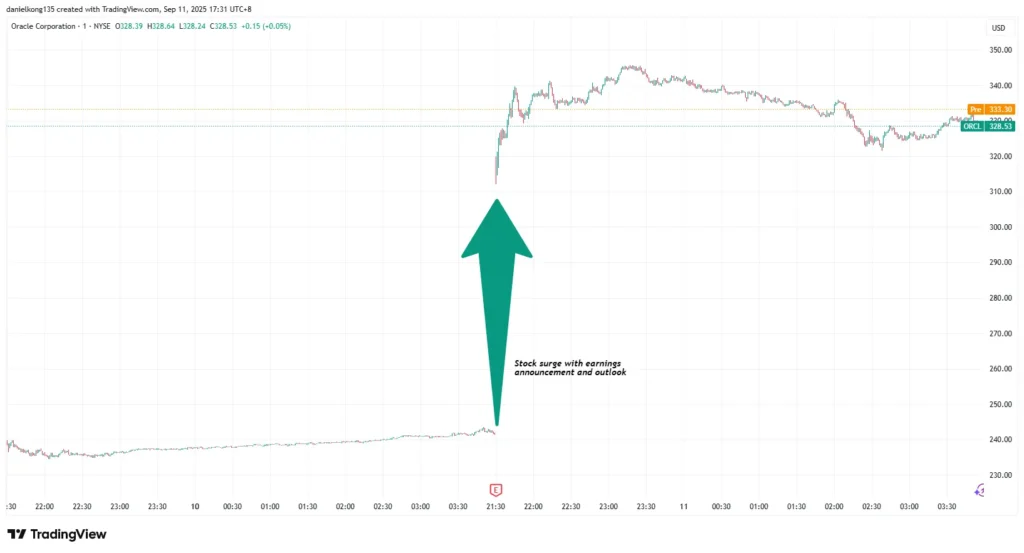
Chart 1: Oracle price chart post earnings announcement. Source: https://www.tradingview.com/x/hmV4rOkh/
Why Do Traders Buy the Rumour and Sell the News?
The saying buy the rumour, sell the news reflects how markets often respond more to anticipation than to actual events. Traders are influenced by sentiment and expectations, which can create price moves well before the official announcement. Once the news is confirmed, many participants sell, leading to the opposite reaction.
Several factors drive this behaviour:
- Anticipation Builds Early: Traders react to rumours, forecasts, or leaks long before the official release, moving prices in advance.
- Reality vs Expectations: Even if the news is good, it may fall short of inflated expectations, prompting disappointment and selling.
- Profit-Taking Behaviour: Early buyers often sell once the event happens to secure gains, putting downward pressure on prices.
- Herd Mentality: Once selling begins, others follow, accelerating the reversal.
- Buy the Hype, Sell the News: Markets are driven as much by psychology as by data, with hype often creating stronger moves than the facts themselves.
Variations of Buy the Rumour, Sell the News
Traders often phrase the idea of buy the rumour, sell the news in different ways, but the principle remains the same. All of these variations point to the same behaviour: markets moving on speculation, then reversing once the event is confirmed.
Here are some of the most common expressions and how they appear in practice:
- Sell on the Rumor, Buy on the News: Sometimes traders expect negative outcomes and sell early, only to buy back when the actual news is less damaging than feared.
- Buy the News, Sell the Rumors: This flips the phrase, describing situations where traders ignore speculation and act only when the official announcement is released.
- Buy on Rumours, Sell on News: A classic variation that highlights buying during speculation and selling once facts arrive.
- Buy on the News, Sell on the Rumor: Less common, but used when rumours exaggerate risks and traders instead wait for the official event to buy.
- Buy News, Sell Rumor: A shorter form of the same idea, often used in trading discussions.
- Sell on News, Buy on Rumour: Describes contrarian behaviour, where traders use confirmed news to exit and rely on speculation to re-enter positions.
- Sell the News, Buy the Rumor: Another popular form that underscores how anticipation can be more powerful than the outcome.
While the wording changes, the principle stays consistent: markets are shaped as much by expectations and psychology as by the facts themselves.
Risks of News Trading
While news trading can create opportunities, it also carries significant risks. Market reactions to breaking events are often unpredictable, and price movements can be extreme within seconds. Anyone considering a news trading strategy should be aware of these risks to better manage their expectations.
Some of the most common risks include:
- Volatility: News releases often cause sudden and sharp price swings. While this volatility can create opportunities, it can also increase the chance of losses if the market moves against a trader’s position.
- Spread Widening: During major announcements, brokers may widen spreads to account for uncertainty. This can raise trading costs and reduce potential returns from short-term moves.
- Slippage: In fast-moving markets, orders may be filled at a different price than expected, particularly around unscheduled or highly impactful news.
- Sudden Reversals: Even if the news aligns with forecasts, markets may react in the opposite direction once traders begin to take profits.
- Liquidity Gaps: In moments of extreme reaction, liquidity can dry up. This makes it harder to enter or exit positions at intended price levels.
These factors show that trading the news is as much about managing risk as it is about spotting opportunity.
News Trading Strategies and Tools
A successful news trading strategy relies not just on reacting quickly but also on preparation. Traders who focus on trading buy sell decisions around key events often use specialised tools to stay ahead. These resources help them anticipate, interpret, and respond to news as efficiently as possible.
Using Economic Calendars
An economic calendar is one of the most important tools for news trading. It lists scheduled announcements such as central bank meetings, employment data, and inflation reports. By tracking these events, traders can anticipate when volatility may rise and plan their strategies accordingly.
Platforms for Fast Execution (e.g. MetaTrader 4/MetaTrader 5)
Speed matters in news trading. Platforms like MetaTrader 4 (MT4) and MetaTrader 5 (MT5) allow quick order execution, custom indicators, and automated trading strategies. Having access to a platform that combines reliability with fast execution can make a significant difference during volatile news releases.
Reliable Market News Sources
Access to accurate and timely information is essential for a news trading strategy. Traders often rely on reputable financial news outlets, real-time feeds, and sentiment tools that scan headlines and social media. Combining these sources helps traders act quickly while filtering out noise.
Conclusion
News trading highlights how market sentiment and speculation can move prices just as strongly as the events themselves. The phrase buy the rumour, sell the news captures this dynamic, where anticipation often drives bigger reactions than the actual outcome.
While news creates volatility and short-term opportunities, it also carries risks such as slippage, sudden reversals, and spread widening. Traders who are aware of these factors are better placed to assess both the potential and the limitations of trading the news.To learn more about trading strategies, tools, and market psychology, explore the resources available at Vantage Academy or open a live trading account with Vantage to access platforms designed for fast execution.
References
- “Oracle’s ‘truly awesome’ quarter stuns Wall Street, sending stock up 36% and making Ellison world’s richest man – Yahoo! Finance”. https://finance.yahoo.com/news/oracles-truly-awesome-quarter-stuns-wall-street-sending-stock-up-36-and-making-ellison-worlds-richest-man-165228458.html . Accessed 11 September 2025.
- “Oracle stock gains 36% to post best day since 1992, adding $244 billion in value – CNBC”. https://www.cnbc.com/2025/09/10/oracle-stock-cloud-backlog-ai.html . Accessed 11 September 2025.