



 Updated
Did you know that gold surged more than 60% in 2025, marking one of its strongest single-year performances in over four decades? Rising from around USD2,600 per ounce at the start of the year to a record high above USD4,300 per ounce, gold outpaced equities, bonds, and most commodities to become one of 2025’s top-performing major asset classes.¹ (Take note that past performance is not indicative of future results.)
What’s more, a 2026 study published in the Journal of Risk and Financial Management found that gold’s role varied across markets and crisis periods. Rather than acting as a universal safe haven at all times, gold functioned as “a hedge for the FTSE 100 and S&P 500 during crisis times”, while acting more as “a diversifier for the CAC 40 and Shanghai Composite Index” during stable market conditions.2
For traders managing a multi-asset portfolio, that raises a practical question: Does gold still diversify a portfolio after such a strong rally—or has it become a concentration risk?
Gold trading strategies for portfolio diversification aren’t about chasing a bull run. Instead, they’re about understanding why gold can behave differently from equities and bonds across market regimes, then using that behaviour deliberately. Gold’s historically low correlation with equities, its sensitivity to real yields and the US dollar, and crisis-driven demand can all shape how it performs relative to the rest of a portfolio.
This guide covers the macro drivers behind gold’s diversification role, relevant trading strategies that reflect those drivers, and the risks of using gold Contracts for Difference (CFDs) as a diversification tool—keep scrolling to find out how you can size and manage gold exposure with more confidence and clarity.
Key Points
- Gold has historically shown a lower correlation with equities and bonds, which may help to reduce reliance on a single market driver, but this relationship is not fixed across all market environments.
- Gold commonly plays three roles in a portfolio: Risk reduction, inflation and currency hedging, and safe-haven exposure during crises—each role requires a different trading approach because gold doesn’t respond to inflation, equity stress, or currency weakness in the same way every time.
- Gold is often described as an inflation hedge, but real yields and US dollar direction can matter more for short-term gold price action than CPI data alone.
- In 2022, gold broadly held its value despite multi-decade high inflation because rapidly rising real yields and a surging US dollar acted as headwinds3—a reminder that inflation alone does not guarantee higher gold prices.
- Gold CFDs allow traders to speculate on gold price movements without owning physical bullion, but leverage can increase portfolio risk and losses if position sizing is not managed carefully.
So, Why Is Gold Often Used In Portfolio Diversification?
Gold is often used in portfolio diversification because it may behave differently from equities, bonds, and currencies during inflation shocks, market stress, or periods of currency weakness. That said, the case for gold isn’t simply that it rises when everything else falls. It’s more nuanced than that.
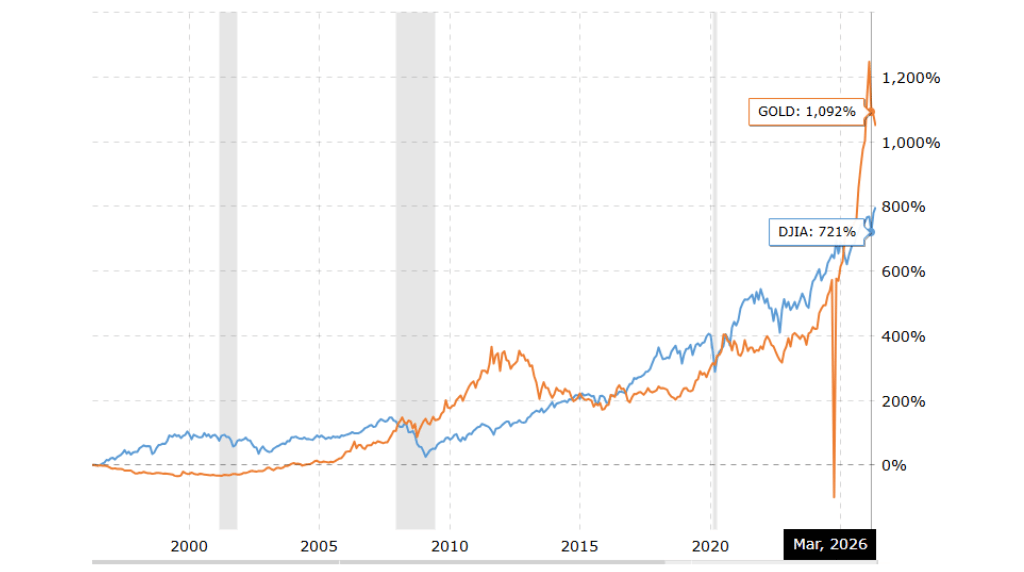
Image credit: Macrotrends4
Low Market Correlation
Gold has historically shown a lower correlation to traditional assets such as equities and bonds. According to the World Gold Council, gold can become more negatively correlated with stocks during extreme equity sell-offs, when diversification is often needed most.5 That matters because contrary to popular misconception, diversification isn’t about owning more instruments—it’s about reducing reliance on the same market driver.
The Global Financial Crisis (GFC) is a clear historical example. Per a 2025 report by Deutsche Bank, gold rose approximately 21% in US dollar terms from December 2007 to February 2009, while equities, real estate, and many commodities fell sharply. That same gold price trend was once again replicated during the sharp equity pullbacks of 2020 and 2022.6
Downside Risk Cushion
Gold has performed well during some—but not all—periods of equity market stress. The macro environment of 2022 serves as a prime case study. Despite multi-decade high inflation and a significant equity drawdown, gold has held its value, ending the year only marginally higher.7 That was still an outperformance relative to most equity and bond indices, but traders and investors need to take note that gold’s protective effect is not automatic.
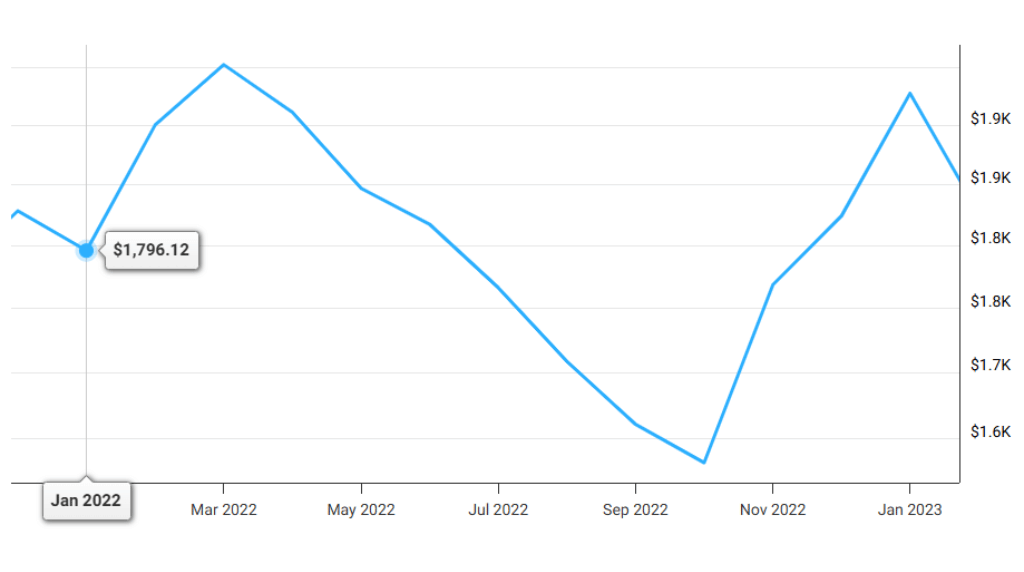
Image credit: macrotrends8
Vantage Pro Tip: Don’t treat gold as a guaranteed hedge; treat it as an asset class that can potentially mitigate portfolio concentration risk when sized correctly within a risk-managed framework.
Inflation Sensitivity and Real Yields
Gold is often described as a direct shield against inflation, but its relationship with CPI data is surprisingly weak. Statistics from the World Gold Council shows that since 1971, inflation numbers alone explain only 16% of gold’s price movements.9 Instead, a better short-term driver might be real yields (the actual interest you earn on bonds after subtracting inflation).
Given that gold doesn’t pay any interest or dividends, holding it can cost you potential income. When interest rates drop, bonds become less attractive, making gold look highly appealing. But when interest rates skyrocket, as they did in 2022 when the US Federal Reserve raised rates from 0.25% in January to 4.5%10 by year-end, real yields surged.

Image credit: Federal Reserve
The US Dollar Factor and Central Bank Demand
As gold is priced in US dollars, a weaker dollar can exhibit a dual effect on gold prices.
- A weaker USD generally pushes the dollar price of gold higher.
- A weakened dollar also makes gold cheaper in other currencies, which can stimulate non-dollar global demand.
Beyond currency shifts, central banks also play a massive role in setting the floor for gold prices. While governments can print money, they cannot print gold.
Since 2022, central banks have been buying gold at unprecedented levels and speeds in a move to diversify their reserves. Even when gold was steadily rising in 2023 and 2024, major economies such as China, India, and Turkey, continued to accumulate huge amounts of the precious metal per a report by the International Monetary Fund (IMF).11
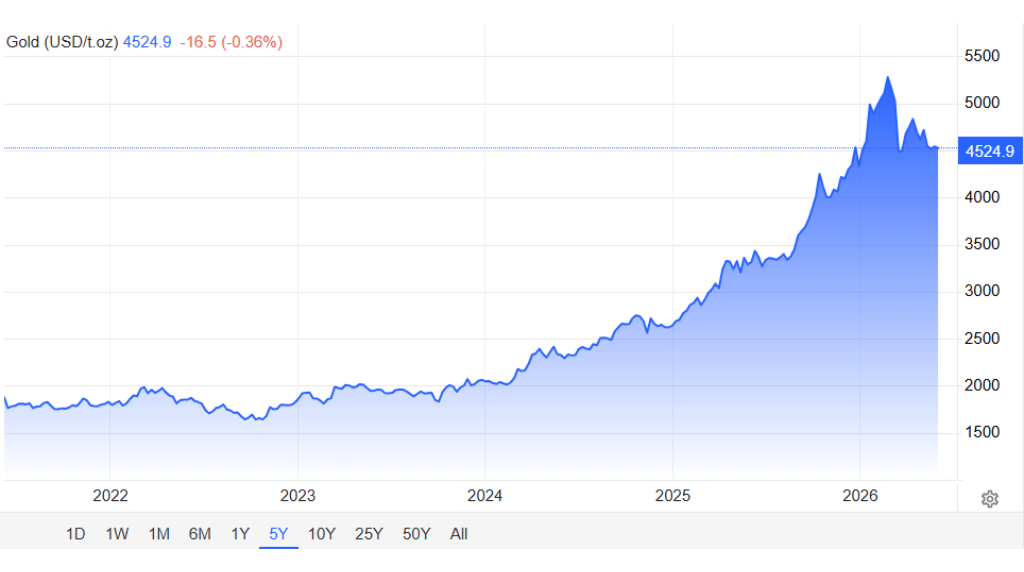
Image credit: Trading Economics12
Safe-Haven and Crisis Demand
During major market shocks such as geopolitical tensions, banking stress, or unpredictable elections, investors typically flock towards gold as a perceived safe-haven asset. However, trading gold during a crisis can come with a hidden technical trap: execution friction.
During fast-moving markets, the gap between the buying and selling price (aka the spread) can widen significantly. Your orders might experience slippage, meaning that they get filled at a much worse price than you anticipated. For traders entering positions right before major global events, it’s a practical risk to account for wider spreads and sudden gaps by reducing the trade size and using more conservative risk management.
How Gold Trading Can Help to Support A Diversified Portfolio
If there’s one thing to take away from this article, it’s that a gold position doesn’t automatically diversify a portfolio.
That’s because if the same macro factor is driving both your gold position and the rest of your holdings, the risk may still be concentrated. The practical test is whether adding gold exposure genuinely reduces correlation across the portfolio—or just adds another bet on the same driver.
The three scenarios where gold trading most clearly supports diversification are:
- Reducing equity-heavy concentration
- Hedging against inflation and dollar weakness
- Providing safe-haven exposure during systemic stress events
Each has a different entry logic and a different risk profile, which we will explore more below.
1. Reduce Overall Portfolio Risk
A portfolio that’s heavily weighted towards equities (or growth-sensitive assets more broadly) may benefit from a measured gold allocation. As mentioned earlier, gold has historically shown a low correlation with traditional risk assets, which means it can behave differently from equities during certain market conditions.
For smoother portfolio behaviour, adding gold to a diversified portfolio might help reduce overall volatility—but this is dependent on the following factors:
- The size of the allocation
- The market environment
- How the position is managed
Vantage Pro Tip: Take note that if a successful gold position grows too large, it can become a concentration risk in itself. That’s why regular portfolio rebalancing is key.
2. Hedge Against Inflation and Currency Devaluation
When inflation expectations rise or the US dollar weakens, gold is often viewed as one of the first assets traders and investors turn to. As a relatively scarce real asset that’s not issued by central banks, gold has long-term appeal in periods of inflationary concerns, monetary uncertainty, or currency weakness.
That said, gold should not be seen as a guaranteed inflation hedge. Its short-term relationship with consumer price inflation can be uneven, and gold prices are often heavily influenced by:
- Real yields
- US dollar movements
- Central bank policy expectations
- Investor sentiment
Instead of viewing gold as a tool that reliably offsets inflation in every market cycle, it’s better to see it as a store-of-value asset and portfolio diversifier.
3. Provide Safe-Haven Exposure During Crises
Geopolitical risk, banking stress, and systemic uncertainty tend to drive flight-to-quality demands for gold. Physical gold held directly doesn’t depend on an issuer and cannot go bankrupt, which is part of its appeal during periods of market stress.
On the other hand, gold CFDs provide exposure to gold price movements without ownership of the underlying metal. This also means that the safe-haven characteristics of physical gold bullion aren’t automatically replicated to the derivative instrument. Always bear in mind that while gold CFDs can offer ample opportunities in fast-moving markets, they also involve additional risks, including but not limited to:
- Leverage
- Margin requirements
- Execution risk
- Overnight funding costs
- Provider risk
5 Gold Trading Strategies For Portfolio Diversification
Gold trading strategies for portfolio diversification are typically built around macro drivers, not just technical setups. Whether you’re a novice trader or a seasoned investor, gold can play different roles in a portfolio depending on the market environment. That said, each strategy should be tied to a clear objective, risk limit, and exit plan.
1. Correlation-Based Gold Strategy
This gold trading strategy addresses the core question of portfolio diversification: Does your gold position actually reduce concentration risk, or does it duplicate an existing exposure?
The approach involves comparing gold exposure against equities, bonds, indices, commodities, and FX positions at the total portfolio level. If the same macro driver, say, US dollar weakness, is already influencing multiple positions, adding a gold CFD may reinforce that exposure rather than offset it.
This is where the earlier 2026 study’s findings2 become practical. If gold’s role can shift between a hedge and a diversifier depending on the market conditions and regime, then correlation cannot be treated as a guarantee. A gold CFD isn’t automatic portfolio diversification simply because it’s a different instrument. What actually matters is whether it can reduce one’s portfolio’s overall sensitivity to a single macro driver.
Correlations should therefore be assessed across different timeframes and market environments. Gold may behave differently during normal trading conditions versus periods of equity stress, inflation shocks, or sharp moves in interest-rate expectations.
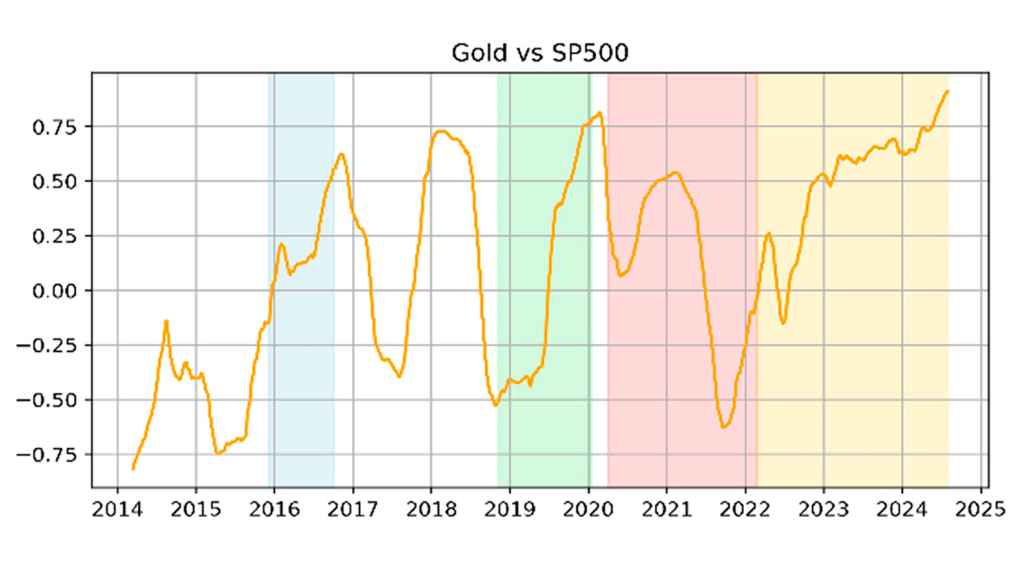
Image credit: Journal of Risk and Financial Management2
Vantage Pro Tip: Traders can use Vantage’s Economic Calendar to monitor upcoming data releases, central bank decisions, and geopolitical events that might move multiple positions at the same time.
2. Safe-Haven Gold Strategy
Another gold trading strategy to consider for portfolio diversification is to use gold to manage exposure during periods of elevated geopolitical risk, banking stress, or sudden equity market weakness. Yet, the entry signal is rarely the news event itself. By the time a crisis is visible, part of the gold move might have already taken place.
More useful signals to look out for might include:
- Sustained equity weakness rather than a single-day drop
- Rising volatility
- Weaker risk appetite across multiple asset classes
- Flight-to-quality flows into assets such as US Treasuries and gold
Traders should also assess whether gold is rising on genuine defensive demand or short-term momentum buying, as these moves can unwind differently.
Vantage Pro Tip: Chasing gold late in a panic rally can leave a position exposed if risk appetite returns and the safe-haven premium unwinds. Stop-loss discipline, position sizing, and a defined exit plan are essential.
Related Article: Gold Trading for Beginners: Complete Guide
3. Inflation and Currency Hedge Strategy
A third gold trading strategy that might be relevant for portfolio diversification monitors the interaction between inflation data, real yields, and US dollar direction, because all three can influence gold—and they don’t always move in the same direction.
Gold could be better supported when real yields are falling and the US dollar is weakening, as both can improve the relative appeal of a non-yielding asset. However, when real yields rise sharply or the US dollar strengthens, those forces can offset the positive effect of elevated inflation expectations. This was visible in 2022, when rising rates, higher real yields, and a strong US dollar created headwinds for gold despite high inflation.
Key indicators to watch typically include:
- US 10-year Treasury yields
- Inflation breakeven rates
- Real yields
- The US Dollar Index (DXY)
- Federal Reserve guidance on the rate path
Vantage Pro Tip: Traders should use sound risk management and avoid assuming that high inflation automatically leads to higher gold prices.
4. Trend-Following Strategy for Gold Exposure
Trend-following uses tools such as moving averages, trendlines, and higher-high/higher-low structures to trade gold’s directional momentum. This approach can suit gold’s macro-driven, regime-dependent price action, especially when a clear theme supports the trend. Some examples include:
- Dollar weakness
- Rate-cut expectations
- Geopolitical escalation
- Central bank demand
The main risk is that gold trends can reverse sharply when the macro regime changes unexpectedly. For example, a shift in Federal Reserve expectations, a stronger US dollar, or improving risk appetite can quickly weaken an existing gold trend.
Vantage Pro Tip: Traders should avoid repeated entries during sideways price action, as gold volatility in ranging markets can generate false signals and erode trading capital.
5. Rebalancing Strategy for Gold Exposure
A successful gold position can become a portfolio risk if it grows too large relative to total holdings.
As such, a rebalancing strategy for portfolio diversification involves systematically reducing gold exposure when:
- It exceeds a target allocation
- The original thesis has played out
- The risk-reward profile has changed
Practical triggers for rebalancing include a gold price move that has moved significantly beyond the original entry thesis, a reversal in the key macro driver, or a position that now represents an outsized share of total portfolio risk.
Vantage Pro Tip: Sound money management in trading and disciplined position sizing are critical to executing this gold trading strategy for portfolio diversification.
4 Key Risks Of Using Gold CFDs For Portfolio Diversification
Using gold CFDs to diversify a portfolio introduces specific risks that don’t apply to physical gold holdings. Understanding this leveraged instrument is as important as understanding the market.
| Risk | Why It Matters | Key Things to Note |
| False hedge risk | Gold may fall during broad liquidation events when traders tend to sell the precious metal alongside other assets to raise cash, which can reduce its effectiveness as a short-term hedge. | Don’t rely on gold as the only defensive position in the portfolio. Use position sizing, stop-losses, and broader diversification to manage downside risk. |
| Counterparty and non-ownership risk | Gold CFDs don’t provide ownership of physical gold bullion. They are derivative contracts with a brokerage, which means traders are exposed to provider, pricing, execution, and contract-specific risks. | Understand the instrument before trading. Physical gold, gold ETFs, futures, and gold CFDs each carry different ownership, custody, liquidity, margin, and execution risks. |
| Liquidity risk | Gold CFD spreads can widen during fast markets, thin liquidity periods, market open or close, major economic releases, central bank announcements, and geopolitical shocks. This can increase trading costs and affect execution quality. | Avoid oversized positions around major macro events. Check spreads, trading hours, margin requirements, and order execution conditions before entering a trade. |
| Leverage risk | A leveraged gold CFD can increase portfolio exposure faster than intended. Even a small move in the underlying gold price can produce a larger percentage gain or loss on the margin used. | Keep position size aligned with total portfolio risk, not just the gold price view. Use margin conservatively and define risk per trade before entering a position. |
One risk that deserves particular attention is leverage.
A gold CFD position sized by leverage alone—without reference to the portfolio’s total risk exposure—can increase concentration rather than reduce it. Leverage amplifies both potential gains and losses, and a sharp move against an oversized position can raise portfolio risk beyond what the trader originally intended.
Liquidity risk is another important consideration. Gold is typically a highly liquid market, but trading conditions can tighten during periods of:
- Extreme volatility (particularly around major market opens and closes)
- Central bank announcements
- High-impact data releases
- Broad deleveraging events
Spreads may widen just when a trader most wants to enter, adjust, or exit a position. Factoring this into position sizing is part of practical risk management.
For traders who understand these risks, gold CFDs might offer a flexible way to take a view on gold price movements as part of a broader portfolio strategy. With a Vantage Live Account, traders can access gold CFD markets, monitor pricing in real time, and explore platform tools such as charts, order types, and risk controls.
Positioning Gold As A Deliberate Portfolio Tool
It’s undeniable that gold’s performance in 2025 was unexpectedly exceptional. But the strategic use case for gold in a diversified portfolio doesn’t depend on chasing past returns.
Instead, it’s all about what drives gold structurally—its historically low correlation with equities in certain stress periods, its sensitivity to real yields and US dollar direction, and its potential role as a crisis hedge (though not always guaranteed). Astute traders and investors would bear those factors in mind before sizing and managing their exposure in a disciplined manner.
If you’re interested in gold CFDs as part of your portfolio diversification strategy, Vantage offers gold CFD trading from 0.01 lot with spreads from 0.0 pips on eligible account types. Spreads are variable and may widen depending on market conditions and account type.
Frequently Asked Questions (FAQs)
Does gold reduce portfolio risk?
Gold may help to reduce portfolio risk when it has a genuinely low correlation to the rest of the portfolio. However, this effect isn’t guaranteed. During broad liquidation events, traders may sell gold alongside other assets to raise cash, which can temporarily reduce its diversification benefit.
World Gold Council analysis shows that in simulated stress scenarios, gold has helped stem portfolio losses by 50–90 basis points13—possibly a meaningful buffer, but definitely not a guaranteed shield. Traders and investors should assess gold exposure alongside total portfolio risk, not in isolation.
Is gold a good hedge against inflation?
Gold is often viewed as an inflation hedge because it’s a scarce real asset that is not issued by central banks. However, the relationship between gold prices and CPI inflation is historically weak. Inflation matters, but real yields and dollar direction can matter more for short-term gold price action.
Is gold a safe-haven asset?
Gold is widely perceived as a safe-haven asset during periods of geopolitical tension, banking stress, or market uncertainty, and the historical evidence generally supports this designation. That said, the level of protection depends on the market environment and the instrument used.
Physical gold held directly has no issuer and cannot default. Meanwhile, a gold CFD carries provider, execution, and leverage risks that are separate from the metal’s safe-haven characteristics. During the global financial crisis, gold rose approximately 21% (in USD) from December 2007 to February 200914 while equities and other risk assets fell sharply. However, individual CFD traders’ results would still have depended on entry price, position size, leverage, margin management, and exit discipline.
Does gold have counterparty risk?
It depends on the instrument. Physical gold held directly has no issuer and cannot default. Gold CFDs, ETFs, futures, certificates, and other gold-linked instruments all carry different types of counterparty, custody, structure, margin, liquidity, or execution risk. Traders should not apply the same risk assumptions across all forms of gold exposure.
A Vantage gold CFD can give traders access to gold price movements without owning the underlying metal. This can offer practical advantages, such as no physical storage requirement and the ability to trade with leverage, but it also introduces practical risks, including margin requirements, execution risk, overnight funding costs, and provider risk.
Knowing which form of gold exposure you are trading is the starting point.
What is the best gold trading strategy for portfolio diversification?
There is no single best gold trading strategy for portfolio diversification. That’s because the right approach depends on the risk a trader is trying to manage. A correlation-based strategy is often the most structurally grounded because it starts with whether gold genuinely reduces portfolio concentration or simply adds to an existing macro exposure.
For traders focused on inflation and currency risk, an inflation-and-real-yields strategy may be more appropriate. Meanwhile, for crisis exposure, a safe-haven strategy may be relevant, but it should not be treated as guaranteed protection.
References
1. “Why Gold Prices Skyrocketed in 2025 – Money” https://money.com/why-gold-prices-skyrocketed-in-2025/. Accessed on 3 June 2026.
2. “Safe Havens in Turbulent Times: Assessing the Role of Gold and the USD Against Global Stock Market Indices – Journal of Risk and Financial Management (MDPI)” https://www.mdpi.com/1911-8074/19/5/308. Accessed on 3 June 2026.
3. “Gold mid-year outlook 2022: Balancing inflation, rate hikes and political uncertainty – World Gold Council” https://www.gold.org/sites/default/files/downloads/2022-07/202206_MidYear_Outlook_2022_final.pdf. Accessed on 3 June 2026.
4. “Gold Price vs Stock Market – 100 Year Chart – Macrotrends” https://www.macrotrends.net/2608/gold-price-vs-stock-market-100-year-chart. Accessed on 3 June 2026.
5. “Gold as a strategic asset: 2026 edition – World Gold Council” https://www.gold.org/goldhub/research/relevance-of-gold-as-a-strategic-asset/key-attributes-diversification. Accessed on 3 June 2026.
6. “Gold & silver in demand, oil price range seems limited – Deutsche Bank Wealth Management” https://wealth.db.com/dam/deutschewealth/insights/investing-insights/asset-class-insight/2025/gold-and-silver-in-demand-oil-price-range-seems-limited.pdf. Accessed on 3 June 2026.
7. “Gold Demand Trends Full Year 2022 – World Gold Council” https://www.gold.org/goldhub/research/gold-demand-trends/gold-demand-trends-full-year-2022. Accessed on 3 June 2026.
8. “Gold Prices – 100 Year Historical Chart – Macrotrends” https://www.macrotrends.net/1333/historical-gold-prices-100-year-chart. Accessed on 3 June 2026.
9. “Investment Update – Beyond CPI: Gold as a strategic inflation hedge – World Gold Council” https://www.gold.org/goldhub/research/beyond-cpi-gold-as-a-strategic-inflation-hedge. Accessed on 3 June 2026.
10. “FOMC’s target range for the federal funds rate – The Federal Reserve Explained” https://www.federalreserve.gov/aboutthefed/fedexplained/accessible-version.htm. Accessed on 3 June 2026.
11. “Gold’s Lasting Luster – International Monetary Fund” https://www.imf.org/en/publications/fandd/issues/series/analytical-series/golds-lasting-luster. Accessed on 3 June 2026.
12. “Gold – Trading Economics” https://tradingeconomics.com/commodity/gold. Accessed on 3 June 2026.
13. “The Portfolio Continuum: Rethinking Gold in Alternatives Investing – World Gold Council” https://www.gold.org/goldhub/research/portfolio-continuum-rethinking-gold-alternatives-investing. Accessed on 3 June 2026.
14. “Gold as a strategic asset: 2024 edition – World Gold Council / Utah State Treasurer” https://treasurer.utah.gov/wp-content/uploads/5-29-2024-Other-Meeting-Materials-World-Gold-Council.pdf. Accessed on 3 June 2026.
RISK WARNING: CFDs are complex financial instruments and carry a high risk of losing money rapidly due to leverage. You should ensure you fully understand the risks involved and carefully consider whether you can afford to take the high risk of losing your money before trading.
Disclaimer: The information is provided for educational purposes only and doesn’t take into account your personal objectives, financial circumstances, or needs. It does not constitute investment advice. We encourage you to seek independent advice if necessary. The information has not been prepared in accordance with legal requirements designed to promote the independence of investment research. No representation or warranty is given as to the accuracy or completeness of any information contained within. This material may contain historical or past performance figures and should not be relied on. Furthermore estimates, forward-looking statements, and forecasts cannot be guaranteed. The information on this site and the products and services offered are not intended for distribution to any person in any country or jurisdiction where such distribution or use would be contrary to local law or regulation.