




CFDs and options are both derivative products, which means their value is based on an underlying asset such as shares, indices, commodities, or forex. While both allow you to seek trading opportunities on price movements without owning the underlying asset, they operate very differently in terms of cost structure, risk profile, and strategic flexibility.
For traders comparing CFDs vs options, the key distinctions often come down to cost, leverage, expiry, complexity, and maximum loss potential. Understanding these differences can help traders decide which product may be more suitable for their objectives and level of experience.
Key Takeaways
- CFDs and options are both derivative instruments that allow traders to seek trading opportunities on price movements without owning the underlying asset, but they differ significantly in structure, cost, and risk profile.
- CFDs carry no fixed expiry date and use leverage, meaning both potential gains and losses can be magnified—losses can exceed your initial deposit.
- Options involve paying a premium upfront, which represents the maximum amount a buyer can lose, while offering more flexibility for hedging and complex trading strategies.
What Are CFDs and Options?
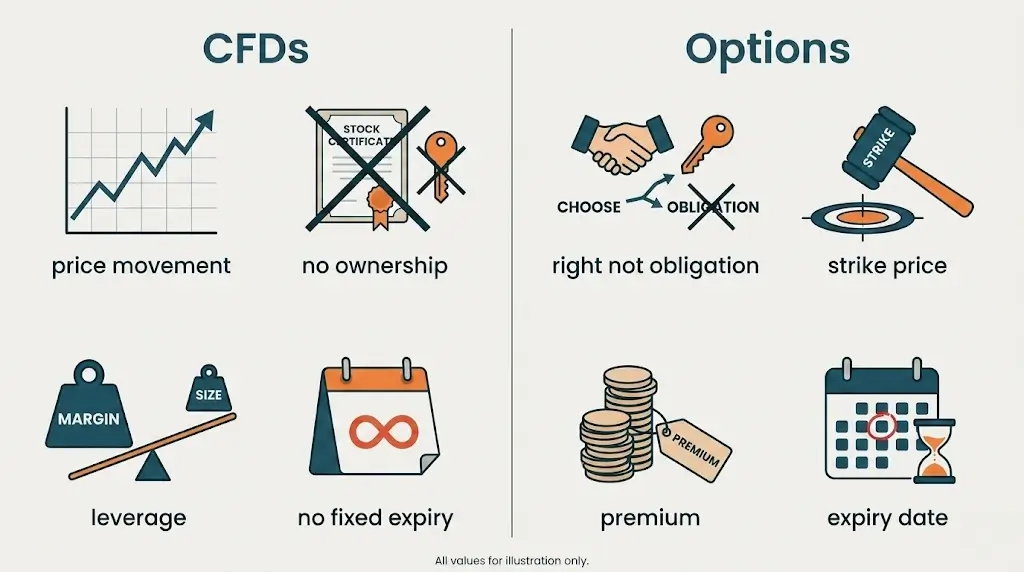
CFDs, or Contracts for Difference, are derivative products that allow traders to speculate on the price movement of an underlying asset without taking ownership of it. Profit or loss is based on the difference between the opening and closing price of the trade, and CFDs are commonly traded on margin.
Options are derivative contracts that give the buyer the right, but not the obligation, to buy or sell an underlying asset at a predetermined price before or on a specified expiry date. Unlike CFDs, options are affected not only by price movement, but also by factors such as time to expiry and volatility.
7 Key Differences Between CFDs and Options
Before diving into the details, the table below provides a side-by-side comparison of CFDs and options across key features:
| Feature | Contracts for Difference (CFDs) | Options |
| Ownership | No ownership of the underlying asset | No ownership, but the right to buy or sell the asset |
| Primary Cost | Spread + overnight financing fees | Premium paid upfront |
| Maximum Loss (Buyer) | Potentially unlimited (can exceed deposit) | Limited to the premium paid |
| Expiry Date | No fixed expiry; positions can be held open | Yes, a fixed expiration date applies |
| Leverage | Yes, leverage is applied | Yes, through the premium structure |
| Complexity | Moderate | Higher, particularly for multi-leg strategies |
| Best Suited For | Short-term trading, trending markets | Hedging, complex strategies, volatile markets |
1. How They Work
The biggest difference between CFDs and options is how the trade itself is structured.
With a CFD, the trader is speculating directly on whether the price of an asset will rise or fall. The profit or loss depends on the difference between the opening price and closing price of the position.
With an option, the buyer purchases a contract that provides the right, but not the obligation, to buy or sell an underlying asset at a fixed price before expiry. This makes options more flexible, but also more complex than CFDs.
2. Cost Structure
CFDs and options involve different types of trading costs.
For CFDs, costs may include the spread, commissions depending on the market, and overnight financing charges for positions held beyond the trading day. This means holding a CFD position over time can add to the overall cost of the trade.
For options, the buyer pays a premium upfront. The value of this premium is influenced by factors such as the underlying asset price, strike price, volatility, and time remaining until expiry. Depending on the market, additional brokerage fees may also apply.
3. Maximum Loss Potential
Risk exposure differs significantly between CFDs and options.
Because CFDs are traded using leverage, losses can exceed the initial margin deposited if the market moves sharply against the position. This makes risk management especially important when trading CFDs.
For an options buyer, the maximum loss is generally limited to the premium paid. If the option expires worthless, the buyer loses only the premium. However, this limited-loss feature does not apply in the same way to options sellers, whose losses can be substantially higher depending on the strategy used.
4. Leverage
Both CFDs and options offer leveraged exposure, but they do so in different ways.
With CFDs, leverage is applied directly through margin. Traders only need to deposit a fraction of the full trade value, which increases both potential gains and potential losses.
With options, leverage is embedded in the premium structure. Since the premium is usually much smaller than the value of the underlying asset, small market movements can produce proportionally larger percentage changes in the option’s value.
5. Expiry and Holding Period
CFDs generally do not have a fixed expiry date. Traders can hold a position open indefinitely, as long as there is sufficient margin in the account and overnight financing costs are covered. The exception is CFDs on futures contracts, which are typically rolled over near the futures’ expiry.
Options, by contrast, have a fixed expiry date. As that date approaches, the time value component of the premium erodes—a phenomenon known as time decay. If the option is out of the money at expiry, it expires worthless and the buyer loses the full premium paid.

6. Complexity
CFDs are generally considered more straightforward because the outcome is mainly tied to the movement of the underlying market.
Options are more complex. Beyond simply buying a call or put, traders can construct multi-leg strategies such as spreads, straddles, or collars. These strategies can be designed to seek trading opportunities in volatile or range-bound markets, or to hedge an existing portfolio—but they require a sound understanding of how options are priced and how different variables interact.
For traders newer to derivatives, CFDs are generally considered more accessible due to their simpler mechanics.
7. Use Cases and Market Conditions
CFDs are commonly used for short-term directional trading, especially by traders looking for direct exposure to rising or falling markets. They are often chosen for their simplicity and ease of access across multiple asset classes.
Options are often used for hedging, income strategies, or more advanced market views involving volatility and timing. Their flexibility is one of their main strengths, but it also means they usually require a deeper understanding of how the contracts behave.
CFDs vs Options vs Futures: A Brief Note
Traders researching CFDs and options may also encounter futures contracts. Like CFDs and options, futures are derivative instruments that allow traders to seek trading opportunities on an asset’s price without owning it.
The key difference is that futures contracts obligate both parties to transact at the agreed price on the expiry date. CFDs, by contrast, have no fixed expiry (for most instruments), while options give the buyer the right—but not the obligation—to transact.
Futures are typically used by institutional investors and traders seeking larger position sizes, and they are exchange-traded with standardised contract terms. CFDs and options may be available over-the-counter (OTC) or on exchange, depending on the broker and the instrument.
Understanding the Risks
Both CFDs and options carry significant risks, and neither is suitable for all traders.
Key risks to be aware of include:
- Leverage risk: Both instruments involve leverage, which can amplify losses as well as potential gains.
- Market risk: Price movements can be rapid and unpredictable, particularly in volatile conditions.
- Liquidity risk: Not all instruments or options contracts are equally liquid, which can affect execution and the ability to exit a position at a desired price.
- Time decay (options): The value of an option erodes as it approaches expiry, which can work against a buyer even if the market moves in the anticipated direction.
- Overnight financing (CFDs): Holding CFD positions overnight incurs financing costs, which can add up over time.
It is important to understand these risks thoroughly before trading either instrument. Traders should also consider whether the instrument is appropriate for their level of experience and financial situation.
CFDs vs Options: Which Is Better?
There is no one-size-fits-all answer when comparing CFDs vs options. CFDs are generally more accessible for traders seeking direct exposure to price movements, while options may appeal to those looking for more flexibility, hedging opportunities, or defined-risk positions as buyers.
The right choice depends on how comfortable a trader is with leverage, expiry, complexity, and the specific risk profile of each product. Before trading either instrument, it is important to understand how it works and whether it aligns with your objectives and level of experience.
Ultimately, neither CFDs nor options is inherently better — the more suitable choice depends on your goals, experience level, and understanding of the risks involved. If, after comparing the two, you feel CFDs may be more aligned with your trading style, you can explore CFD trading in more detail, practise first with demo trading, or open a live account when you are ready.
Frequently Asked Questions (FAQ)
What is the main difference between a CFD and an option?
The main difference lies in structure and risk profile. A CFD tracks the price of an underlying asset directly, and your gain or loss reflects the price difference between entry and exit. An option gives the buyer the right—but not the obligation—to buy or sell at a set price before a fixed expiry date. Options buyers pay a premium upfront, and their maximum loss is limited to that premium. CFD losses, however, are not capped and can exceed the initial deposit.
Are CFDs or options better for beginners?
CFDs are generally considered more accessible for those newer to derivative trading, primarily because of their simpler structure. You take a directional view, and your outcome is tied directly to price movement. Options involve additional variables—such as strike price, expiry date, time decay, and implied volatility—that make them more complex to understand and manage. That said, the defined-risk nature of buying options (where maximum loss is the premium paid) is sometimes cited as a consideration for risk-conscious traders. Neither instrument is without risk, and both require a solid understanding before trading.
Can you lose more money than you invest with CFDs?
Yes. Because CFDs use leverage, losses can exceed the margin deposited to open a position. This means a trader’s account balance can go into deficit if a position moves significantly against them. Some brokers offer negative balance protection, which prevents a balance from falling below zero, but this is not universally available and may vary by jurisdiction. It is important to understand your broker’s policies and use risk management tools such as stop-loss orders.
Do CFDs and options expire?
Most CFDs do not have a fixed expiry date and can be held open indefinitely, subject to margin requirements and overnight financing charges. An exception applies to CFDs based on futures contracts, which typically have a roll-over date near the underlying futures’ expiry. Options, by contrast, always have a fixed expiry date. If an option is out of the money at expiry, it expires worthless and the buyer loses the full premium paid.
Is CFD trading the same as options trading?
No. While both are derivative instruments that allow traders to seek trading opportunities on price movements without owning the underlying asset, they are distinct products with different structures, cost models, and risk profiles. CFDs track price difference directly with no expiry, while options give the buyer a right to transact at a fixed price before a set date, with the premium serving as the cost and maximum loss for the buyer.
RISK WARNING: CFDs are complex financial instruments and carry a high risk of losing money rapidly due to leverage. You should ensure you fully understand the risks involved and carefully consider whether you can afford to take the high risk of losing your money before trading.
Disclaimer: The information is provided for educational purposes only and doesn’t take into account your personal objectives, financial circumstances, or needs. It does not constitute investment advice. We encourage you to seek independent advice if necessary. The information has not been prepared in accordance with legal requirements designed to promote the independence of investment research. No representation or warranty is given as to the accuracy or completeness of any information contained within. This material may contain historical or past performance figures and should not be relied on. Furthermore estimates, forward-looking statements, and forecasts cannot be guaranteed. The information on this site and the products and services offered are not intended for distribution to any person in any country or jurisdiction where such distribution or use would be contrary to local law or regulation.