



 Updated
Calculating lot size, pips, and risk-to-reward starts with three separate figures: how many units a position covers, how much a single price increment is worth, and how the planned loss compares with the planned gain. Lot size sets the number of units in a forex Contract for Difference (CFD) position, a pip is the smallest standard price step that instrument can move, and risk-to-reward ratio weighs the distance to a stop-loss against the distance to a take-profit before a trade is even placed.
Together, these three figures decide what a single price movement is actually worth in dollar terms, and whether a planned position fits a trader’s risk tolerance. This guide sets out the formula behind each calculation, a quick-reference table for converting common lot sizes into their pip value, and a worked example showing how gold (XAU/USD) pip values differ from standard currency pairs.
This article is provided for general educational purposes only and should not be regarded as investment advice, a recommendation, or a solicitation to trade any financial instrument.
Key Points
- Lot size is calculated by multiplying the number of lots by the contract size, with standard, mini, micro, and nano lots representing 100,000, 10,000, 1,000, and 100 units respectively.
- Pip value changes with lot size and the quote currency, which is why the same 50-pip move is worth $500 on a standard lot but only $5 on a micro lot.
- Risk-to-reward ratio is calculated by dividing the distance to a planned take-profit by the distance to a planned stop-loss, and pairing it with a risk-based position size keeps the dollar amount at stake consistent across trades.
What Is Lot Size in Forex Trading?
A lot is the standardised unit Vantage and other brokers use to size a forex Contract for Difference (CFD) position, rather than quoting trades in raw currency units. A lot represents a fixed number of units of the base currency, and that number changes depending on the lot category a trader selects.
Lot sizing plays a central role in risk management, because it is the lever that decides how much a given price movement is worth. Forex lot sizes fall into four categories: standard, mini, micro, and nano.
| Category | Lot Size | Units |
| Standard | 1 Lot | 100,000 |
| Mini | 0.1 Lot | 10,000 |
| Micro | 0.01 Lot | 1,000 |
| Nano | 0.001 Lot | 100 |
Mini, micro, and nano lots are smaller divisions of the standard lot, used by traders who want to reduce the dollar value of each price movement rather than reduce the leverage applied. A micro lot accounts for 1% of a standard lot, and a nano lot for 0.1%, though nano lots are only offered by a limited number of brokers.
How to Calculate Lot Size
To convert a lot size into the number of units it represents, multiply the lot size by the contract size for that instrument. For a standard forex pair, where the contract size is 100,000 units of the base currency, the formula is:
Units Traded = Lot Size × Contract Size
For example, a trader opening 0.50 lots of EUR/USD is trading 0.50 × 100,000 = 50,000 units of EUR, the base currency in the pair. The same formula works in reverse to find out how many lots a given unit size represents.
What Are Pips in Forex Trading?
A pip is the smallest standard price increment a currency pair can move, short for “percentage in point.” Most forex pairs are quoted to four decimal places, which places the pip at the fourth decimal — for example, EUR/USD moving from 1.0900 to 1.0901 is a one-pip move.
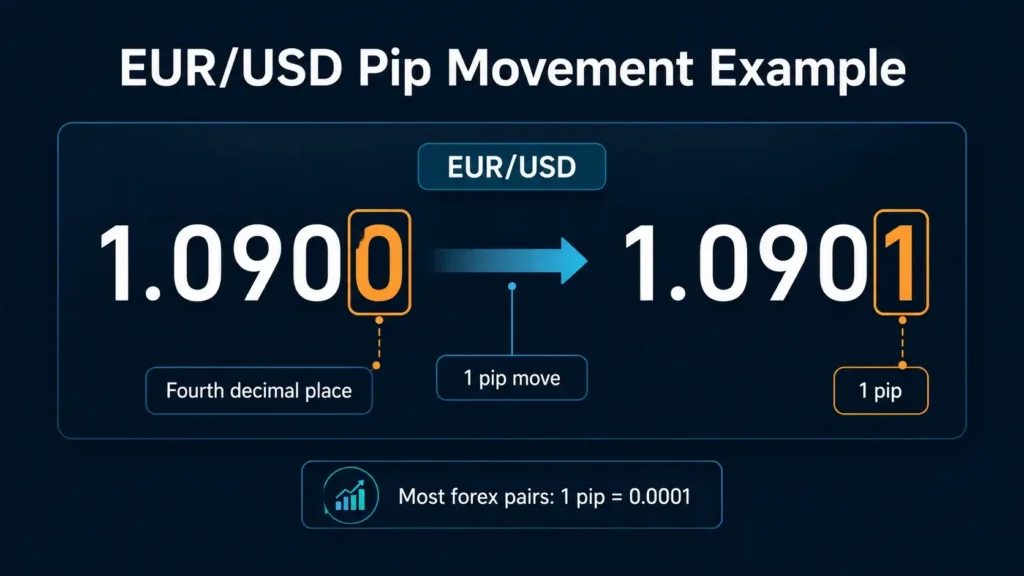
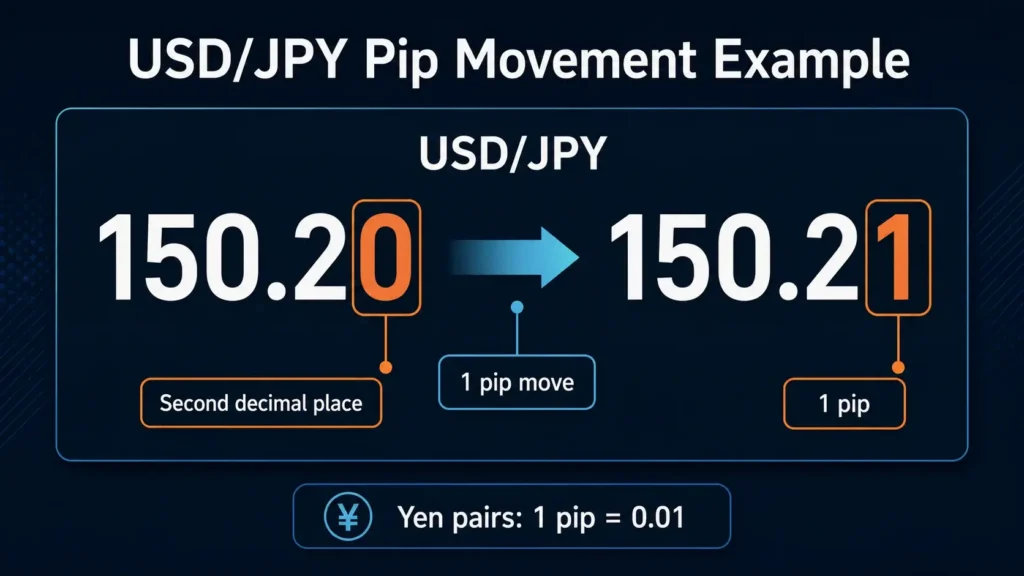
Pairs that include the Japanese yen are the main exception, since the pip sits at the second decimal place instead of the fourth. This happens because one yen is worth a small fraction of a US dollar, so pricing the pair to four decimal places would create units too small to be practical for trading.
Pip Value Formula
Pip value is the dollar amount a single pip is worth for a given position, and it depends on three things: the pip size, the lot size traded, and the exchange rate. The general formula is:
Pip Value = (Pip Size ÷ Exchange Rate) × Units Traded
For currency pairs quoted with the US dollar as the second currency in the pair, such as EUR/USD or GBP/USD, this simplifies in practice to approximately $10 per pip on a standard lot, $1 on a mini lot, and $0.10 on a micro lot, because the pip value and the lot size scale together.
Where the US dollar is not the quote currency, the pip value needs converting from the pair’s quote currency into US dollars using the current exchange rate.
Pip Value by Lot Size (Quick Reference)
| Lot Category | Lot Size | Approx. Pip Value (USD-Quoted Pairs) |
| Nano | 0.001 | $0.01 |
| Micro | 0.01 | $0.10 |
| Mini | 0.1 | $1.00 |
| Standard | 1.0 | $10.00 |
| 10 Standard Lots | 10.0 | $100.00 |
These figures hold for pairs where the US dollar is the quote currency. For other pairs, the pip value shifts with the live exchange rate, so many traders confirm the exact figure through their trading platform before sizing a position.
How Pip Values Differ for Gold (XAUUSD)
Gold CFDs are quoted to two decimal places rather than four, so one XAUUSD pip equals a $0.01 price move instead of the 0.0001 used on most currency pairs. Applying the standard forex pip formula to gold gives the wrong answer, because the contract size and price structure differ from a currency pair.
Gold (XAUUSD) recently traded near $4,040 per ounce, according to Investing.com [2]. At that level, a standard gold lot (100 ounces) is worth $1 per pip, a mini lot (10 ounces) is worth $0.10 per pip, and a micro lot (1 ounce) is worth $0.01 per pip.
| Lot Category | Lot Size (Ounces) | Pip Value |
| Standard | 100 oz | $1.00 |
| Mini | 10 oz | $0.10 |
| Micro | 1 oz | $0.01 |
Gold’s daily volatility is also typically higher than most currency pairs, which can affect how stop-loss levels are approached, while the mechanics of counting gold pips follow the same $0.01 pip size used here, applied across long and short positions.
Related article: XAU/USD Trading Strategies: Tips and Techniques for Gold CFD Traders
How Lot Size and Pip Value Work Together
Lot size and pip value combine to set the dollar amount at stake on every price movement, which is the figure that actually matters once a trade is open.
Consider a hypothetical EUR/USD CFD position opened at 1.0900, with a stop-loss set at 1.0850 and a take-profit set at 1.1000. The distance to the stop-loss is 50 pips, and the distance to the take-profit is 100 pips. Suppose the trader opens the position using a 0.10-lot (mini lot) size, where each pip is worth approximately $1, as shown in the pip value table above.
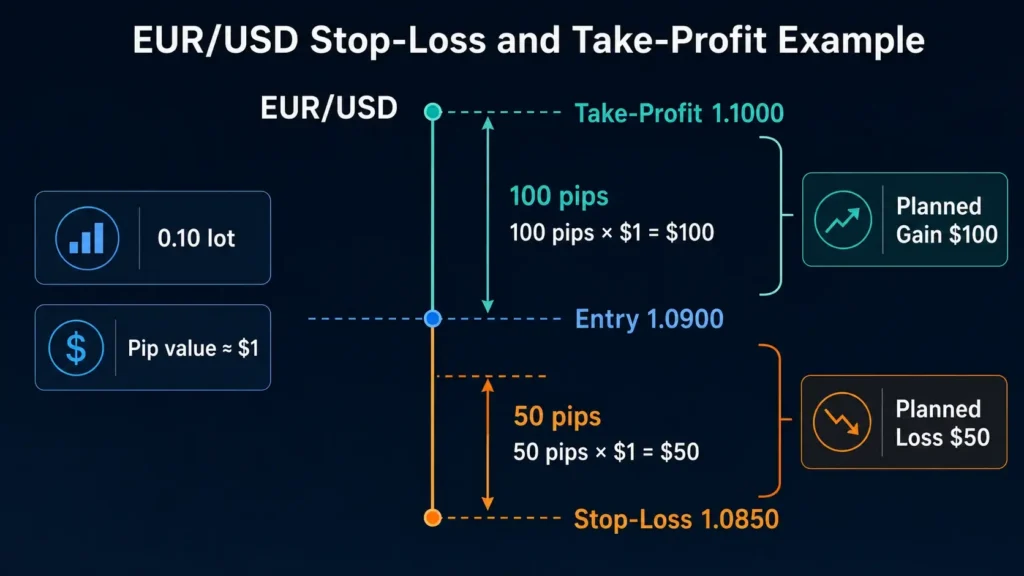
At that lot size, the planned loss if the stop-loss is hit works out to 50 pips × $1 = $50, and the planned gain if the take-profit is hit works out to 100 pips × $1 = $100.
This example is hypothetical and for illustrative purposes only and does not reflect actual trading results or client experiences.
How to Calculate Position Size Using Risk Management
Lot size is rarely chosen at random in practice. Most traders work backwards from how much they are willing to risk on a single trade, then size the position to match. The formula is:
Lot Size = Risk Amount (USD) ÷ (Stop-Loss in Pips × Pip Value per Lot)
Using the same EUR/USD scenario, suppose the trader has a $5,000 account and is not willing to risk more than 1% of it, or $50, on a single position. With the 50-pip stop-loss already set and a standard lot’s pip value of approximately $10, the calculation works out to $50 ÷ (50 × $10) = 0.10 lots — the same mini-lot size used in the worked example above.
This is general information only and does not constitute financial advice. Individual circumstances vary.
The 1% figure is one of several reference points traders use; some use 2%, and the right amount depends on factors such as account size, leverage, and how many positions are open at once. Leverage changes the margin required to open the position, magnifying both gains and losses by the same degree, but it does not change the pip value or the dollar risk calculated above — it only changes how much of a trader’s own capital is tied up while the position is open.
What Is the Risk-to-Reward Ratio in Forex Trading?
Risk-to-reward ratio compares the distance to a planned take-profit against the distance to a planned stop-loss, expressed as a ratio rather than a dollar figure. The formula is:
Risk-to-Reward Ratio = Distance to Take-Profit ÷ Distance to Stop-Loss
In the EUR/USD example used throughout this guide, the take-profit sits 100 pips away and the stop-loss sits 50 pips away, giving a ratio of 100 ÷ 50 = 2, or 1:2. In dollar terms, on the 0.10-lot position sized earlier, that means risking $50 for a planned gain of $100.
A higher ratio is not automatically better. Setting a stop-loss and take-profit purely to chase a high ratio, such as 1:10, can place the take-profit at a level the market rarely reaches, which lowers the odds of the trade completing as planned even if the ratio looks attractive on paper. The ratio works best read alongside a strategy’s typical win rate rather than in isolation.
| Ratio | Risk | Reward | What It Implies |
| 1:1 | $50 | $50 | Needs a win rate above 50% to be profitable over time |
| 1:2 | $50 | $100 | Used in the example above; may be viable for strategies with different win rates depending on market conditions |
| 1:3 | $50 | $150 | Larger profit target for the same risk; may need a longer hold time to reach |
This example is hypothetical and for illustrative purposes only and does not reflect actual trading results or client experiences. Past performance, including any backtested win rate, is not a reliable indicator of future results.
Putting Lot Size, Pips, and Risk-to-Reward Into Practice
Lot size, pip value, and risk-to-reward ratio are not three separate skills — they are one calculation viewed from different angles. The lot size decides how many units are at stake, the pip value translates price movement into dollars, and the risk-to-reward ratio checks whether the planned trade is structured sensibly before it opens.
Working through the figures before a position opens, rather than after, is what turns a price chart into a number a trader can actually manage. The same three steps apply whether the instrument is a major currency pair or a gold CFD, with only the pip size and contract specification changing between them.
Frequently Asked Questions
How many pips are in one standard lot?
A pip itself is not “in” a lot — pip count measures price movement, while lot size measures position size. What changes between the two is the pip’s dollar value: on a standard lot (100,000 units) of a USD-quoted pair, each pip is typically worth around $10, compared with roughly $1 on a mini lot and $0.10 on a micro lot.
What is the formula for calculating lot size in forex?
Lot size can be calculated two ways depending on the goal. To convert lots into units, multiply the lot size by the contract size (1.0 lot × 100,000 = 100,000 units for a standard forex pair). To size a position around a fixed risk amount instead, the formula is Lot Size = Risk Amount ÷ (Stop-Loss in Pips × Pip Value per Lot), which accounts for both the stop-loss distance and how much capital a trader is prepared to risk.
How much is a 0.01 lot worth in dollars?
A 0.01 lot is a micro lot, equal to 1,000 units of the base currency. On a USD-quoted pair such as EUR/USD, each pip on a micro lot is typically worth around $0.10, so a 20-pip move represents roughly $2 in profit or loss. This differs from the position’s full notional value, which is the lot size multiplied by the contract size and the instrument’s current price.
How do you calculate pips for gold (XAUUSD)?
Gold quotes use two decimal places, so one XAUUSD pip equals a $0.01 price move rather than the 0.0001 used on most currency pairs. On a standard XAUUSD lot (100 ounces), each pip is worth $1; on a mini lot (10 ounces) it is worth $0.10, and on a micro lot (1 ounce) it is worth $0.01.
What is a pip risk calculator?
A pip risk calculator estimates the dollar value of a stop-loss before a trade is placed by combining the lot size, the pip value for the instrument being traded, and the stop-loss distance in pips. It serves the same purpose as the manual position-sizing formula described above, automating the calculation so a trader can check planned risk against account size in advance.
What is considered a good risk-to-reward ratio in forex?
There is no single ratio that suits every trade, since it depends on a strategy’s win rate and the specific setup. Many traders work with ratios between 1:1.5 and 1:3, on the basis that the planned reward should be larger than the planned risk, though a smaller ratio can still be viable for strategies with a higher win rate. This is general information only and does not constitute financial advice; individual circumstances vary and independent advice should be sought.
RISK WARNING: CFDs are complex financial instruments and carry a high risk of losing money rapidly due to leverage. You should ensure you fully understand the risks involved and carefully consider whether you can afford to take the high risk of losing your money before trading.
Disclaimer: The information is provided for educational purposes only and doesn’t take into account your personal objectives, financial circumstances, or needs. It does not constitute investment advice. We encourage you to seek independent advice if necessary. The information has not been prepared in accordance with legal requirements designed to promote the independence of investment research. No representation or warranty is given as to the accuracy or completeness of any information contained within. This material may contain historical or past performance figures and should not be relied on. Furthermore, estimates, forward-looking statements, and forecasts cannot be guaranteed. The information on this site and the products and services offered are not intended for distribution to any person in any country or jurisdiction where such distribution or use would be contrary to local law or regulation.
References
- “Global FX trading hits $9.6 trillion per day in April 2025 and OTC interest rate derivatives surge to $7.9 trillion: Triennial Survey – BIS” https://www.bis.org/press/p250930.htm Accessed 30 June 2026
- “XAU/USD – Gold Spot US Dollar Price – Investing.com” https://www.investing.com/currencies/xau-usd Accessed 30 June 2026