




Important: This article is for informational purposes only and does not constitute financial advice. All data is sourced from publicly available information as at Q1 2026 and should be independently verified. Investing involves risk, including the possible loss of principal.
Why Gold ETFs Deserve Attention in 2026
Gold has emerged as one of the most compelling assets of the past two years. Propelled by persistent inflation, a shifting global trade landscape, escalating geopolitical tensions, and central bank diversification away from the US dollar, the gold price surged more than 60% in 2025 — its best single-year performance in over four decades. As of early 2026, gold continues to press towards fresh all-time highs, and investor interest has followed accordingly.

There are many ways one can invest in gold, whether it’s acquiring the physical asset, buying stocks or ETFs, or trading contracts for differences (CFDs) on gold prices. For most investors, the most practical and cost-efficient way to gain exposure is through a gold ETF. These exchange-traded funds let you track the gold price (or gain exposure to gold mining companies) directly through your brokerage account, without the logistical burden of buying, storing, insuring, or eventually selling physical bullion. You get the price exposure; the ETF handles everything else.
But the gold ETF universe is more varied than it might appear. Funds differ considerably on annual fees, underlying assets, custodian structures, geographic storage locations, and how closely they track the spot price. Choosing the wrong fund for your investment style or holding period can quietly erode returns over time — particularly for long-term investors where even a seemingly small fee difference compounds into a meaningful cost.
This guide cuts through the noise. We compare the top gold ETFs available to global investors in 2026, covering physically-backed bullion funds, gold miner ETFs, and specialist options, with a focus on the factors that matter most: what each fund actually holds, what it costs to own, and who it’s best suited for.
A note on data: All AUM figures, expense ratios, and performance data in this article are sourced from ETF provider factsheets and publicly available financial data as at Q1 2026. Markets move — always verify current figures with the fund provider before making investment decisions.
Key Takeaways
- Best for liquidity & scale: GLD (SPDR Gold Shares): over US$176B AUM, deepest options market
- Best balance of cost and liquidity: IAU (iShares Gold Trust): 0.25% expense ratio, US$80B+ AUM
- Lowest fees (physical gold): IAUM (iShares Gold Trust Micro): just 0.09% per year
- Best ESG option: SGOL (abrdn Physical Gold Shares ETF): responsibly sourced, Swiss vault storage
- Best for gold mining exposure: GDX (VanEck Gold Miners ETF): ~US$33B AUM, 50+ global miners
- Gold delivered over 60% returns in 2025, one of its strongest years since 1979
What Is a Gold ETF?
A gold ETF is an investment fund that trades on a stock exchange, priced and bought in the same way as an ordinary share. Rather than requiring you to purchase physical gold bars or coins — a process that involves finding a dealer, paying storage and insurance costs, and eventually managing a resale — you simply buy units in a fund that already handles the gold exposure for you.
Most gold ETFs covered in this guide are “physically backed,” meaning the fund actually holds gold bullion in a vault on behalf of investors. A smaller category — gold miner ETFs — instead holds shares in gold-producing companies, offering a different (and typically more volatile) kind of gold-linked exposure. Practically speaking, you can buy and sell gold ETF units through any standard brokerage account during exchange hours. For global investors, the largest and most liquid gold ETFs are listed on the NYSE Arca exchange in the United States, though local equivalents are available in many markets.
Key Terms to Know Before You Start Trading
| Term | What it Means |
|---|---|
Expense Ratio (ER) | The annual management fee charged by the ETF, expressed as a percentage of your investment. Deducted automatically from fund value — not billed separately. |
AUM | Assets Under Management — the total market value of all assets held in the fund. Larger AUM generally indicates greater stability and liquidity. |
Physically Backed | The ETF actually holds gold bullion in a vault, rather than using derivatives or futures contracts to replicate the price. |
Allocated Gold | Your gold is individually identified and ring-fenced — specific bars are assigned to the fund in the vault. |
Bid/Ask Spread | The difference between the price to buy and the price to sell at any moment. A hidden but real transaction cost, particularly relevant for active traders. |
Custodian | The bank or institution responsible for physically holding and safeguarding the gold on behalf of the ETF and its investors. |
LBMA | London Bullion Market Association — the international body that sets standards for gold bar quality and the gold trading market. |
Physical Gold ETFs vs. Gold Miner ETFs: Understanding the Difference
Before selecting a gold ETF, it’s important to understand the fundamental distinction between these two categories. They behave very differently, suit different investor profiles, and carry different levels of risk.
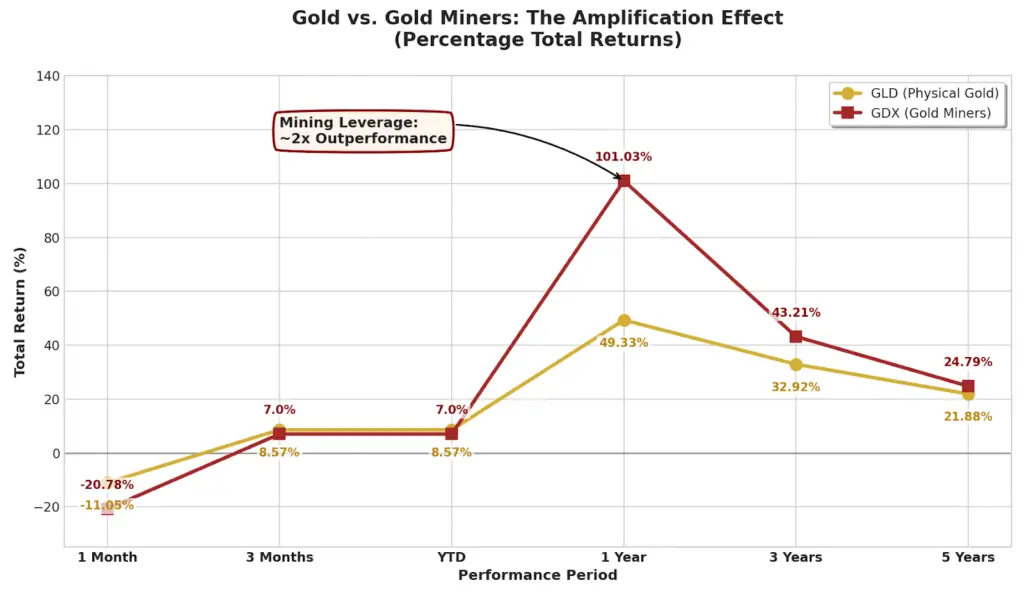
Physical gold ETFs hold actual bullion in vaults. Their price moves in direct proportion to the gold spot price, minus the annual management fee. There are no dividends, no earnings seasons, and no CEO-specific risk. For most investors seeking a reliable hedge against inflation, currency depreciation, or market stress, physical gold ETFs are the cleaner, lower-complexity choice.
| Feature | Physical Gold ETF | Gold Miner ETF |
|---|---|---|
| What it holds | Gold bullion in a vault | Shares of gold mining companies |
| Primary return driver | Gold spot price movements | Gold price + mining company performance |
| Volatility | Moderate | High — can amplify gold price moves significantly |
| Dividends | No | Sometimes (e.g. GDX pays annual dividend) |
| Company risk | None | Yes — operational, financial, management risk |
| Upside in gold bull markets | Tracks gold closely | Can significantly outperform gold |
| Downside risk | Lower — tracks gold price | Higher — company issues add downside |
| Best suited for | Diversification, capital preservation, long-term holders | Higher-risk positioning, active investors |
Gold miner ETFs hold shares in companies that explore, mine, and sell gold. Their performance is influenced by the gold price, but also by factors entirely specific to the mining industry: production costs, labour disputes, regulatory risk, management decisions, debt levels, and operational efficiency. In strong gold bull markets, miners can significantly amplify the gains of the metal itself — but they can also underperform badly when the gold price stagnates or when company-specific problems emerge. They are higher risk, higher potential reward instruments.
The Best Physically-Backed Gold ETFs in 2026
SPDR Gold Shares (GLD)
Best for: Maximum liquidity and institutional-grade trading
GLD was the first US-listed fund to offer physically backed exposure to gold, and it remains the gold standard for investors seeking direct exposure to the price of the yellow metal. With over US$176 billion in AUM in early 2026 — more than double iShares Gold Trust’s AUM — it is the world’s largest gold ETF.
GLD’s scale means exceptional liquidity, a deep options chain, and tight bid/ask spreads, making it the preferred choice for frequent traders and large institutional positions. The trade-off is its higher expense ratio of 0.40%. For frequent trading or large-size trades, GLD’s higher liquidity can reduce execution cost and slippage, sometimes outweighing its higher annual fee.
Key Facts:
- Expense ratio: 0.40% per annum
- AUM: US$176B+ (largest gold ETF globally)
- Listed: 2004 (NYSE Arca)
- Custodian: JPMorgan Chase, London
- Gold price return in 2025: ~62–64%
iShares Gold Trust (IAU)
Best for: Long-term, buy-and-hold investors — best balance of cost and liquidity
IAU is almost identical to SPDR Gold Shares in structure, tracking the same gold price, but with a lower expense ratio of 0.25%. It is large (over US$80 billion in AUM) and highly liquid, storing gold with JPMorgan Chase in vaults in the US and London to LBMA standards. For most long-term retail investors, IAU represents an excellent middle-ground between cost and accessibility.
Over a 20-year holding period, a US$100,000 investment in IAU would incur roughly US$5,000 in management fees, versus approximately US$8,000 in GLD — a meaningful difference that compounds over time.
Key Facts:
- Expense ratio: 0.25% per annum
- AUM: US$80B+
- Listed: 2005 (NYSE Arca)
- Custodian: JPMorgan Chase, US & London
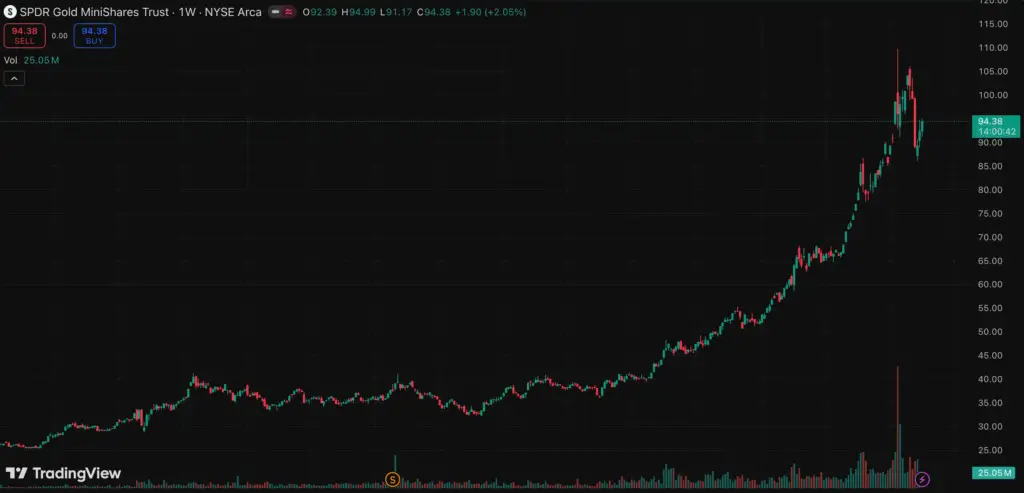
SPDR Gold MiniShares (GLDM)
Best for: Cost-conscious investors who want State Street’s structure at a lower price
GLDM is State Street’s lower-cost alternative to GLD, designed for retail and long-term investors who don’t need GLD’s institutional-scale liquidity. Its lower per-share price also makes it more accessible for investors building positions with smaller amounts of capital. For a long-term, cost-conscious investor, GLDM can offer a better risk-adjusted path than GLD.
Key Facts:
- Expense ratio: 0.10% per annum
- Listed: 2018 (NYSE Arca)
- Gold stored: London vault network
iShares Gold Trust Micro (IAUM)
Best for: Minimising fees above all else
IAUM is the winner in the gold ETF fee war, charging just 0.09% per annum — the lowest available among physical gold ETFs. With roughly US$6 billion in assets, size and tradability are not concerns for most investors. Its lower share price also makes it easy to build a position with modest capital.
Over a 20-year horizon, a US$100,000 investment in IAUM would incur only around US$1,800 in fees — compared to roughly US$8,000 in GLD. For investors who plan to hold gold for the long term without frequent trading, this fee advantage is material.
Key Facts:
- Expense ratio: 0.09% per annum (lowest physical gold ETF)
- AUM: ~US$6 billion
- Listed: 2021 (NYSE Arca)
- Custodian: JPMorgan Chase
abrdn Physical Gold Shares ETF (SGOL)
Best for: ESG-conscious investors and geographic diversification of gold storage
SGOL holds only London Good Delivery gold bullion bars refined on or after January 1, 2012 — all refined in accordance with the London Bullion Market Association’s Responsible Gold Guidance. It had nearly US$9 billion in AUM in early 2026.
A standout feature is its geographic diversification: gold is held in Zurich, Switzerland, through UBS, along with additional holdings in London via JPMorgan. SGOL publishes the serial numbers of its gold bars and conducts regular independent inspections for full transparency. Switzerland’s long history as a haven for capital appeals to investors concerned about concentrating custodial risk in US or London vaults alone.
Key Facts:
- Expense ratio: 0.17% per annum
- AUM: ~US$9 billion
- Custodians: UBS (Zurich) + JPMorgan (London)
- Listed: 2009 (NYSE Arca)
- ESG: Responsibly sourced gold only
Goldman Sachs Physical Gold ETF (AAAU)
Best for: A low-cost alternative outside the BlackRock/State Street duopoly
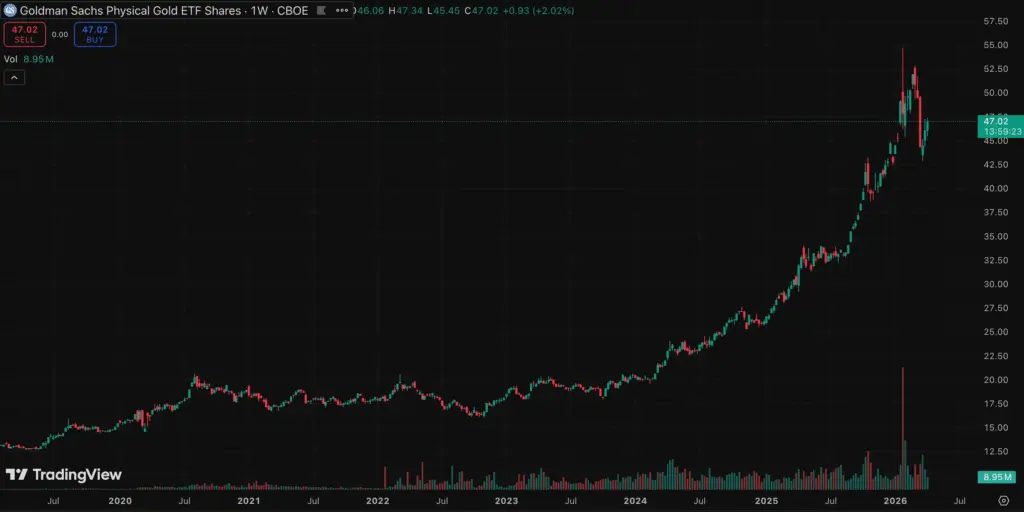
AAAU (the ticker references gold’s chemical symbol “Au”) tracks the London Gold Fixed Price in US dollars and offers a solid value proposition, undercutting both GLD and IAU at 0.18%. Gold is held in London vaults by ICBC Standard Bank and is fully allocated, meaning every share directly corresponds to specific physical gold holdings.
Key Facts:
- Expense ratio: 0.18% per annum
- Custodian: ICBC Standard Bank, London
- Fully allocated storage
- Listed: 2018 (NYSE Arca)
The Best Gold Miner ETFs
Gold miner ETFs invest in shares of companies that extract gold, rather than holding bullion. They can deliver higher returns than physical gold in a strong bull market — but carry additional risks from operational issues, rising production costs, and company-specific events.
VanEck Gold Miners ETF (GDX)
Best for: Diversified exposure to the world’s major gold producers
GDX is the largest ETF focused on major gold mining stocks. As of early 2026, the ETF had nearly US$33 billion in AUM and held over 50 gold mining companies. Its top holdings include the largest gold miners in the world by market capitalisation, led by Agnico Eagle Mines at 9.9%, followed by Newmont and Barrick. GDX pays an annual dividend and offers this broad exposure at a 0.51% expense ratio.
Key Facts:
- Expense ratio: 0.51% per annum
- AUM: ~US$33 billion
- Holdings: 50+ global major gold miners
- Top holdings: Agnico Eagle (~9.9%), Newmont, Barrick
- Listed: 2006 (NYSE Arca)
- 1-year return (to Q1 2026): ~67%+
- Dividend: Yes (annual)
VanEck Junior Gold Miners ETF (GDXJ)
Best for: Higher-risk, higher-upside exposure to smaller mining companies
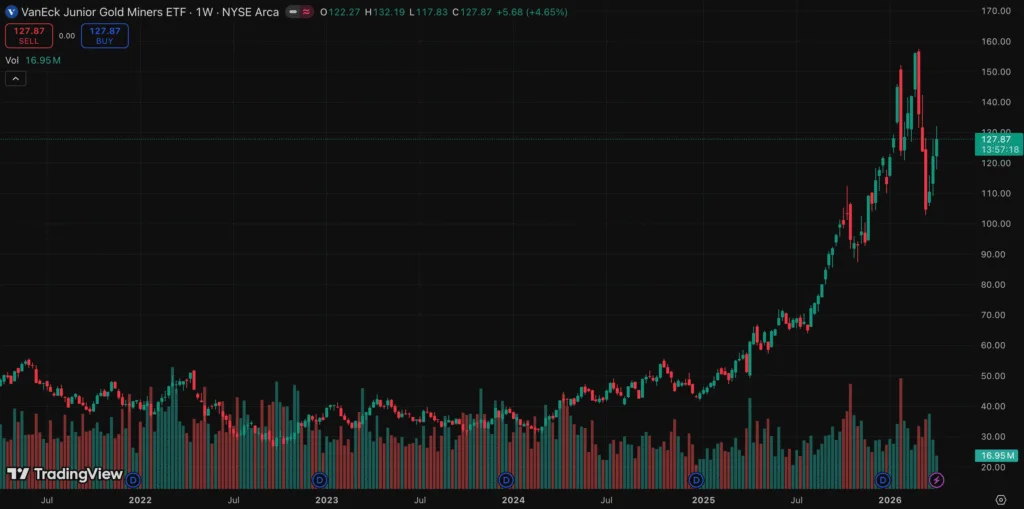
GDXJ focuses on junior gold miners — smaller companies often in earlier stages of exploration or development. It tracks the MVIS Global Junior Gold Miners Index with a 0.51% expense ratio and approximately US$10.5 billion in AUM.
Junior miners carry significantly more risk than large producers, but in strong gold bull markets they can dramatically outperform both physical gold and large-cap miners. This ETF suits investors with a high risk tolerance and a specific outlook on smaller mining operations.
Key Facts:
- Expense ratio: 0.51% per annum
- AUM: ~US$10.5 billion
- Focus: Junior/smaller gold miners globally
- Listed: 2009 (NYSE Arca)
What to Look for When Choosing a Gold ETF
Now that you know more about Gold and Gold Miner ETFs, it’s important to compare the key characteristics of each ETF carefully before making any trading or investment decisions. Before selecting a gold ETF, weigh these five factors:
- Expense ratio — This annual fee compounds significantly over time. Even a 0.20% difference can amount to thousands of dollars on a large position over a decade. See the fee comparison chart above.
- Fund size (AUM) — Larger funds are less likely to be closed, less prone to manipulation, and typically more liquid. Aim for at least US$1 billion in AUM as a minimum.
- Bid/ask spread — This is an often-overlooked trading cost. GLD stands out with its exceptionally high trading volume, which helps keep transaction costs low and reduces market impact. For infrequent, long-term investors, the expense ratio matters more.
- Storage and custody — Consider where the gold is held and by whom. Some investors prefer geographic diversification (e.g., SGOL’s Swiss vault) or full gold allocation, where your specific bars are individually identified.
- Access and tax treatment — Most gold ETFs covered here are listed on NYSE Arca (US). Depending on your country of residence, your broker access, and your account type, some ETFs may be more accessible or tax-efficient than others. Tax treatment also varies — always consult a qualified financial or tax adviser.
Important: Trading Gold ETF CFDs is different from investing in ETFs directly. When trading CFDs, you do not own the underlying ETF or any physical gold. CFDs are leveraged derivative products that allow traders to speculate on price movements and carry a significantly higher level of risk, including the risk of losses exceeding your initial deposit in certain circumstances. The ETF information above is provided for general educational purposes only. The following section explains how Gold ETF CFDs can be traded through Vantage.
How Gold ETF CFDs Can Be Traded on Vantage
Earlier we mentioned that one of the many ways to invest in gold includes trading contracts for differences on the price of gold. CFD trading is a derivative strategy allowing traders to speculate on price movements of assets without owning them. Traders profit from the difference between the opening and closing prices with the ability to go long or short. To start CFD trading gold ETFs with Vantage:
- Sign up with Vantage and complete the verification process for your CFD trading account.
- Fund your account via bank transfer
- Search by ticker — e.g., GLD, IAU, GLDM, IAUM, SGOL, GDX, or GDXJ
- Place a trade position based on your market view — market orders execute at the current market price, while limit orders allow you to specify your preferred entry price.
- Monitor your position — ETF prices update in real-time during trading hours
Frequently Asked Questions (FAQ) About Gold ETFs
What is the best gold ETF to buy in 2026?
The right choice depends on your individual goals, risk tolerance, and investment horizon. As a general comparison: IAU offers a balance of lower cost (0.25%) and strong liquidity; IAUM has the lowest fee at 0.09% among physical gold ETFs; GLD provides the deepest liquidity and is widely used by active traders; and GDX offers exposure to gold mining companies rather than the metal itself. This is not a personal recommendation — consider seeking independent financial advice before making any investment decision.
What is the difference between GLD and IAU?
Both track the price of physical gold and are backed by bullion held with JPMorgan. The key differences are cost and fund size. GLD charges 0.40% per year versus IAU’s 0.25%, and is more than twice as large. For traders and institutions, GLD’s superior liquidity and options depth matter. For buy-and-hold retail investors, IAU or GLDM typically offer better long-term value.
Are gold ETFs safe?
Physical gold ETFs are considered lower-risk than individual stocks or gold miner ETFs, but they still carry market risk — gold prices can and do fall. Physically-backed ETFs avoid the counterparty risk of futures-based products, since bullion is held in vaults. That said, ETF units are not identical to owning physical gold outright, and investors should understand the custodian structure and any applicable risks. Leveraged gold ETFs (not covered in this guide) carry significantly higher risk and are not suitable for most investors.
Do gold ETFs pay dividends?
Physical gold ETFs do not pay dividends — gold produces no income. Gold miner ETFs like GDX do sometimes pay dividends from distributions by their underlying mining company holdings.
How are gold ETFs taxed?
Tax treatment varies significantly by country. In the United States, physical gold ETFs are often classified as collectibles and may be subject to a higher capital gains tax rate than equities — holding them in a tax-advantaged account (e.g., an IRA) can mitigate this. In the UK, standard capital gains tax rules typically apply. Tax treatment in Australia and other markets differs again. Always consult a qualified tax adviser in your jurisdiction before investing.
What is the cheapest gold ETF?
IAUM (iShares Gold Trust Micro) charges just 0.09% per year, making it the lowest-cost physical gold ETF available. GLDM (0.10%) and SGOL (0.17%) are also competitive on fees. Over long holding periods, even small fee differences compound into meaningful cost savings.
Can I redeem my gold ETF units for physical gold?
For most large gold ETFs (GLD, IAU, IAUM, SGOL), only authorised participants — typically large financial institutions — can directly redeem shares for physical bullion. Individual retail investors cannot directly claim gold bars. Some specialist products, particularly in Australia (such as PMGOLD and NUGG on the ASX), do offer retail bullion redemption. If physical delivery is important to you, check the fund’s prospectus carefully before investing.
What is a gold miner ETF, and how does it differ from a physical gold ETF?
A gold miner ETF holds shares in gold mining companies rather than gold bullion itself. Returns are driven by both the gold price and the operational and financial performance of individual mining companies. In strong bull markets, miners can significantly outperform physical gold; but they also carry additional downside risk from production issues, rising costs, and company-specific problems. Physical gold ETFs are more predictable and lower-volatility for most investors.
RISK WARNING: CFDs are complex financial instruments and carry a high risk of losing money rapidly due to leverage. You should ensure you fully understand the risks involved and carefully consider whether you can afford to take the high risk of losing your money before trading.
Disclaimer: This article is for informational purposes only and does not constitute financial or investment advice. Past performance is not indicative of future results. All data cited is sourced from publicly available information as at Q1 2026 — figures including AUM, fees, and returns should be independently verified with the ETF provider’s current prospectus or factsheet. Investing involves risk, including the possible loss of principal. Tax treatment varies by jurisdiction. Consult a licensed financial adviser before making investment decisions.
Data sources: State Street Global Advisors (ssga.com), BlackRock / iShares (ishares.com), abrdn (aberdeenstandard.com), VanEck (vaneck.com), Goldman Sachs Asset Management, Motley Fool, Kiplinger, ETF Database, Mezzi.