


 Updated
Oil markets are showing signs of life again. After months of weak sentiment and price declines, Market sentiment has turned more optimistic as signs of progress emerge in the US–China trade dialogue.
Expectations of smoother trade flows and stronger industrial activity are restoring confidence in global demand, just as the supply side remains tightly managed by OPEC+ and constrained by ongoing sanctions on Russia and Iran.
Together, these dynamics are reviving hopes that crude prices could stabilise at higher levels in the months ahead.
To understand what is driving this renewed momentum, let’s explore three key forces shaping the current market: trade optimism, OPEC+ supply strategy, and geopolitical risks.
Key Points
- Progress in US–China trade talks has lifted market confidence, supporting expectations of stronger global oil demand.
- OPEC+ continues to manage supply cautiously, balancing price stability with flexibility amid sanctions and production limits.
- New sanctions and geopolitical tensions are adding a risk premium to oil prices, keeping market sentiment cautiously optimistic.
Trade Breakthrough Rekindles Demand Optimism
The tone in oil markets has brightened as Washington and Beijing edge closer to a meaningful trade framework that could delay new tariffs, ease China’s export restrictions on critical materials, and reopen smoother trade channels between the world’s two largest economies.
For energy markets, this is more than diplomacy and it could turn out to be a potential turning point for global demand. China remains the world’s largest crude importer, with September imports rising 3.9% year-on-year to 11.5 million barrels per day as refineries ran near peak capacity [1].
Any improvement in trade flows typically ripples through manufacturing, shipping, and logistics, boosting the need for diesel, jet fuel, and petrochemicals. A breakthrough deal that reduces friction between the US and China could breathe life back into Asia’s industrial engines, supporting refinery runs and restocking cycles into 2026.
Earlier this year, the International Energy Agency (IEA) warned that global demand growth might slow to 1.2 million barrels per day due to trade and economic headwinds [2]. That outlook is now being reassessed.
Market analysts are starting to price in potential upside if the trade thaw leads to stronger industrial output and regional consumption. Market data from Shanghai and Singapore already point to higher refinery utilisation and product exports, early signs that energy demand may be stabilising.
In short, the mere expectation of renewed US–China cooperation has been enough to lift sentiment across Asia’s manufacturing hubs. In the oil market, optimism often moves prices before barrels ever get rolling.
Open a live account now and start trading oil CFDs with Vantage as renewed US–China trade optimism influences market sentiment.
OPEC+ Production Outlook and Supply Dynamics
While demand expectations are improving, supply remains the balancing act. Oil rarely moves in a straight line. It reflects the constant push and pull between producers and consumers. At the centre of that dynamic is OPEC+, the alliance that brings together OPEC members and non-OPEC partners such as Russia and Kazakhstan.
Learn more about how supply and demand shape oil prices in our detailed article.
According to the latest IEA report, OPEC+ is on track to raise production by 1.4 million barrels per day this year, followed by another 1.2 million barrels per day in 2026 [3]. Meanwhile, non-OPEC producers like the US, Brazil, Canada, and Guyana are cautiously adding barrels but avoiding an aggressive supply surge.
OPEC+ ministers have emphasised their readiness to adjust output “if required,” maintaining flexibility amid sanctions-related disruptions. A Kuwaiti minister told Reuters in late October that the group could roll back previous cuts if needed to stabilise markets, particularly following new US sanctions on Russian oil firms.
From a market perspective, this optionality is viewed as an important factor. The alliance wants to keep prices supported without over-tightening the market, but signalling excess capacity also keeps a lid on speculative rallies. That explains why crude prices, though firmer, have not broken decisively higher.
In effect, the market is weighing rising demand expectations against cautious supply management, a classic “tug-of-war” between optimism and restraint.
Sanctions and Geopolitical Risk Premiums
Beyond production decisions, the other powerful force shaping oil prices is geopolitical risk. Sanctions and regional tensions continue to inject volatility into the market, raising the so-called “risk premium” embedded in prices.
In recent weeks, the US has imposed new sanctions on major Russian producers, including Lukoil and Rosneft, while tightening enforcement on Iran-related shipping networks. These actions complicate trade logistics and elevate compliance costs, making it more difficult and expensive for sanctioned barrels to reach global markets.
Although Russian and Iranian exports continue to flow through alternative channels, such as the so-called “shadow fleet,” the disruption risk remains significant. These measures effectively raise the floor under Brent crude, as buyers price in the possibility of supply shortfalls or transport delays.
This geopolitical backdrop also amplifies market sensitivity to demand shifts. When supply is perceived as fragile, even small positive signals, such as progress in trade negotiations, can trigger outsized price reactions.
Market Reaction and Price Levels
So how has the market responded? Over the past two weeks, oil prices have recovered meaningfully from October’s lows, reflecting the new balance between improving demand expectations and ongoing supply discipline.
WTI Crude Oil
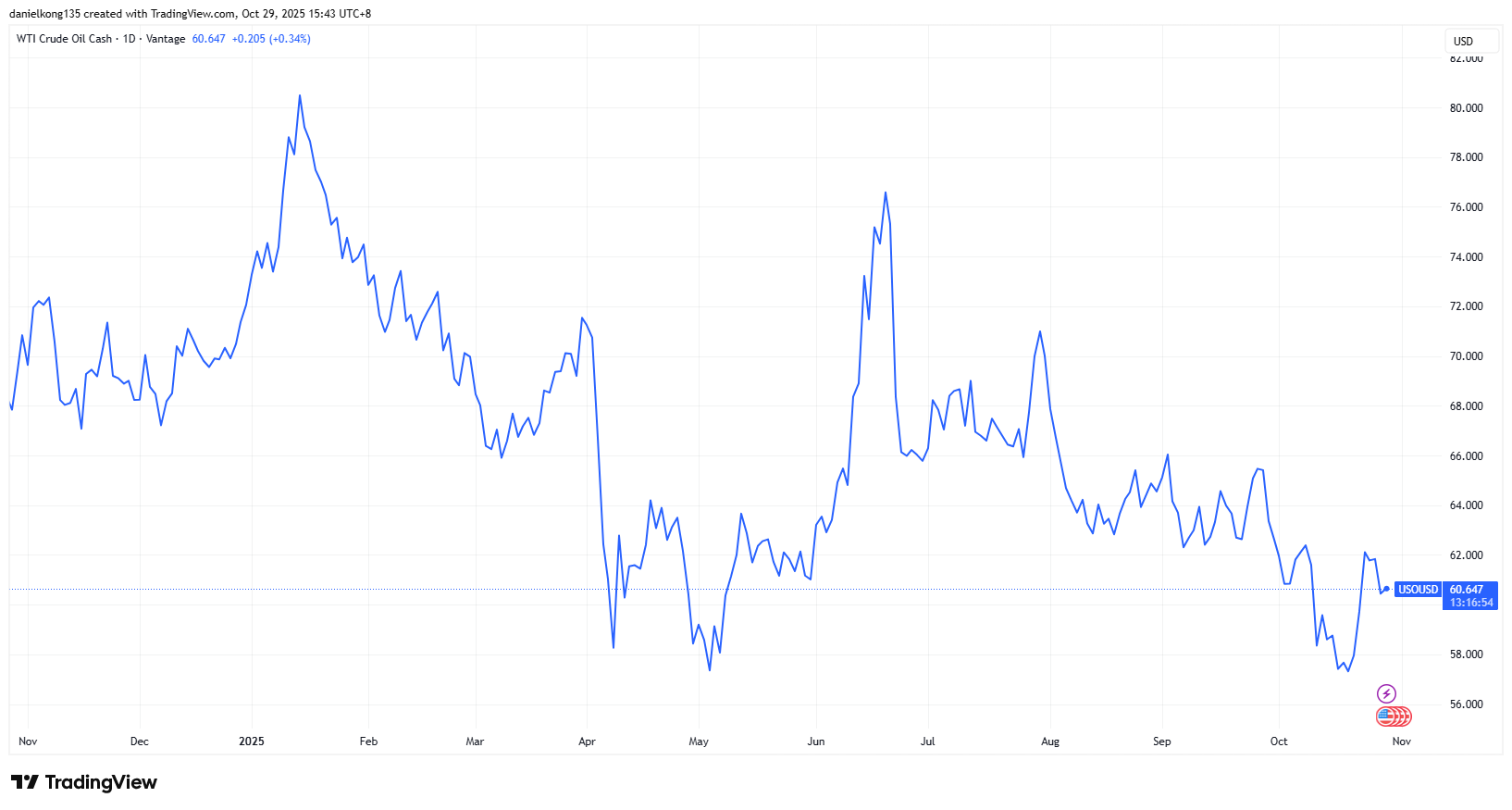
Oil prices are showing signs of recovery after a steep decline, with West Texas Intermediate (WTI) crude, the US benchmark, rebounding from a near five-month low of US$57 per barrel, last seen during May’s selloff.
The rebound toward US$60 marks a notable shift in sentiment, driven by renewed optimism that a potential US–China trade framework could stabilise global trade flows and revive industrial demand.
Investors are increasingly betting that improved economic cooperation between the two largest economies could translate into stronger energy consumption across Asia and beyond. Still, the recovery remains fragile. Every rally has met resistance as traders weigh the prospect of OPEC+ adjusting output against an uncertain macroeconomic backdrop.
For now, WTI is consolidating within a US$58 to US$62 per barrel range, a sign that while downside pressure may be easing, the market is waiting for firmer evidence of demand strength before committing to a sustained uptrend.
Technical perspective: Building a support base with a mildly positive short-term bias
From a technical standpoint, WTI is attempting to build a base after rebounding from its May-low near US$57 per barrel, a key support level.
The short-term bias has turned mildly positive, with prices consolidating between US$58–62 level, though upside momentum remains limited below the 50-day moving average around US$63.
The Relative Strength Index (RSI) has recovered from oversold territory, indicating that selling pressure is easing, but trading volumes suggest caution. A sustained break above US$63 could open room toward US$65, while failure to hold above US$58 risks another pullback toward the US$56–57 zone.
Brent Crude Oil
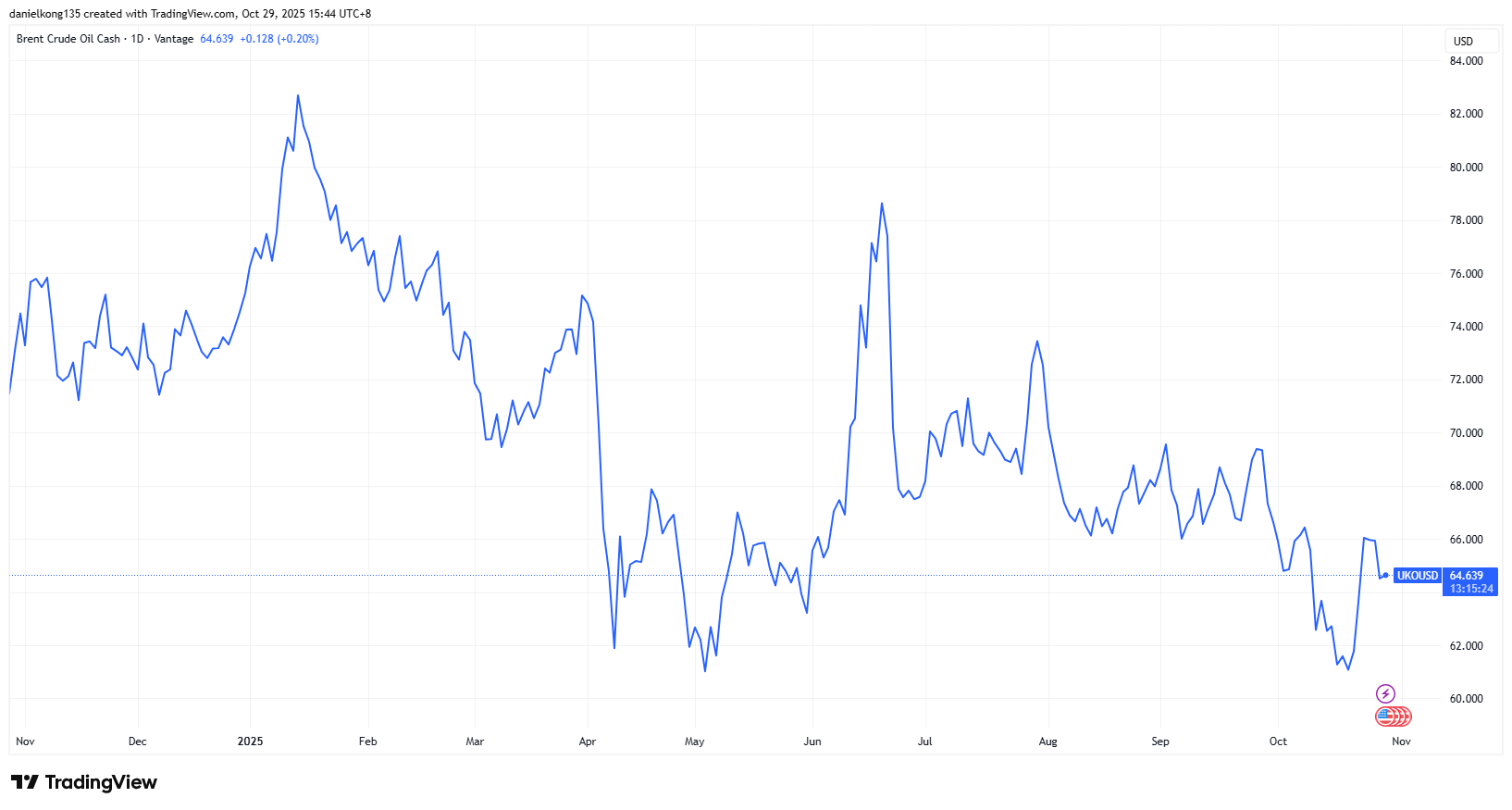
Brent, the global benchmark, mirrored WTI’s trajectory but maintained a slightly firmer tone due to its sensitivity to maritime trade and European demand. The trade breakthrough narrative and new sanctions added upward pressure, while supply expansion fears kept gains in check.
As the world’s benchmark for seaborne crude, Brent has also benefited from improving refinery margins in Asia and early indications of higher product exports from China and India.
However, gains remain limited as markets balance the possibility of stronger demand against uncertainty over OPEC+ production decisions and the impact of ongoing sanctions on Russia and Iran. For now, prices remain range-bound, reflecting a cautiously constructive tone rather than a full-fledged rally.
Technical Perspective: Find support near US$62 and a breakout above resistance signals stronger momentum
From a technical standpoint, Brent crude is stabilising after finding solid support near US$62, a level that has repeatedly attracted buying interest. The short-term outlook appears neutral to slightly bullish, with resistance seen around US$66–67, followed by the 50-day moving average near US$68.
A sustained breakout above these levels could open the door toward US$70, signaling stronger momentum. On the downside, support at US$61–62 remains critical, with a breach likely to expose US$59.
The RSI has recovered from oversold territory, suggesting easing downside momentum, though the lack of strong trading volume implies that the rebound is still in its early stages.
Open a live account now and start trading WTI and Brent CFDs with Vantage to respond to live market movements in real time.
What Matters Next: Outlook, Opportunities, and Risks
Oil’s rebound now faces a critical test, with the US–China trade framework emerging as the key swing factor. A finalised agreement could cement demand expectations through 2026, while another breakdown might quickly erase the renewed optimism.
At the same time, geopolitical risks are re-intensifying after Israel ordered new strikes in Gaza, threatening a fragile ceasefire brokered by the US. The escalation jeopardises regional stability and could reintroduce a risk premium into energy markets that still remain highly sensitive to Middle East supply disruptions.
OPEC+ discipline continues to provide an important counterbalance. The alliance’s gradual production increases of roughly 100,000 to 150,000 barrels per day are manageable for the market, but any acceleration could pressure prices [4].
Conversely, if crude trades near the US$60–65 range for an extended period, higher prices may tempt US shale and other non-OPEC producers back into the market, effectively capping further upside.
While near-term sentiment has clearly improved, the medium-term outlook remains more complex. According to the IEA’s October report, global oil supply is projected to exceed demand by almost 4 million barrels per day in 2026, an unprecedented annual surplus.
The IEA noted that inventories are already building on ocean-going tankers and warned that crude stockpiles could surge as those barrels move onshore to major hubs. The oversupply stems from a combination of rising non-OPEC output and the gradual revival of OPEC+ production, even as demand growth slows in China and other key markets.
Meanwhile, US sanctions on Rosneft and Lukoil have disrupted Russian crude flows, prompting Chinese refiners such as Sinopec to cancel Eastern Siberia-Pacific Ocean (ESPO) purchases, pushing the grade from a premium to a discount versus Brent.
These developments highlight how oversupply risks and shifting trade dynamics could temper the current rebound, keeping the market cautiously balanced between optimism and vulnerability.
For investors, the outlook remains delicately balanced. Demand sentiment has improved alongside hopes of a US–China trade breakthrough, while OPEC+ continues to manage supply with measured discipline, and geopolitical tensions add a modest risk premium.
Yet the recent warnings from the IEA of a potential record oversupply in 2026, coupled with sanctions disrupting Russia’s ESPO crude exports to Asia, serve as reminders that the market’s foundation is still fragile.
Brent is likely to hover between US$60 and US$66, with WTI a few dollars lower, reflecting a market leaning cautiously bullish but wary of renewed volatility. The mood has shifted from fear to fragile confidence, and as oil history shows, confidence can fade just as quickly as a rally begins.
Open a live account now and start trading oil CFDs with Vantage to seize potential opportunities as the market balances between optimism and volatility.
RISK WARNING: CFDs are complex financial instruments and carry a high risk of losing money rapidly due to leverage. You should ensure you fully understand the risks involved and carefully consider whether you can afford to take the high risk of losing your money before trading.
Disclaimer: The information is provided for educational purposes only and doesn’t take into account your personal objectives, financial circumstances, or needs. It does not constitute investment advice. We encourage you to seek independent advice if necessary. The information has not been prepared in accordance with legal requirements designed to promote the independence of investment research. No representation or warranty is given as to the accuracy or completeness of any information contained within. This material may contain historical or past performance figures and should not be relied on. Furthermore estimates, forward-looking statements, and forecasts cannot be guaranteed. The information on this site and the products and services offered are not intended for distribution to any person in any country or jurisdiction where such distribution or use would be contrary to local law or regulation.
References
- “China’s September oil imports rise 3.9% on year, drop 4.5% from August – Reuters”. https://www.reuters.com/business/energy/chinas-september-oil-imports-rise-39-year-drop-45-august-2025-10-13/ . Accessed 29 Oct 2025.
- “Oil Market Report – April 2025 – IEA”. https://www.iea.org/reports/oil-market-report-april-2025 . Accessed 29 Oct 2025.
- “Oil Market Report – October 2025 – IEA”. https://www.iea.org/reports/oil-market-report-october-2025 . Accessed 29 Oct 2025.
- “OPEC+ agrees further oil output boost from October to regain market share – Reuters”. https://www.reuters.com/business/energy/opec-agrees-further-oil-output-boost-october-regain-market-share-2025-09-07/ . Accessed 29 Oct 2025.