


 Updated
Few companies illustrate the highs and lows of the semiconductor industry quite like Intel Corporation (NASDAQ: INTC). Once the undisputed leader of computing power, Intel shaped entire eras of personal and enterprise technology.
From the dominance of the PC age to the turbulence of the smartphone and AI revolutions, Intel’s journey has been marked by both world-changing innovations and costly missteps.
Today, the company is in the midst of a carefully orchestrated Intel turnaround. Strategic restructuring, new leadership, and massive capital commitments reflect the scale of the challenge.
Against this backdrop, the Intel SoftBank deal, a $2 billion investment announced in August 2025, provides both validation and urgency for Intel’s bid to reclaim relevance in a fiercely competitive semiconductor industry [1].
Key Points
- Intel’s history shows its rise to PC dominance, decline in the smartphone era, and growing challenges from AMD, NVIDIA, and TSMC.
- The turnaround strategy centres on massive fab investments, diversification into AI and data centres, and building Intel Foundry Services.
- Backing from SoftBank and the US government highlights Intel’s strategic importance, with foundry success seen as critical to its future.
Intel’s Historical Market Performance
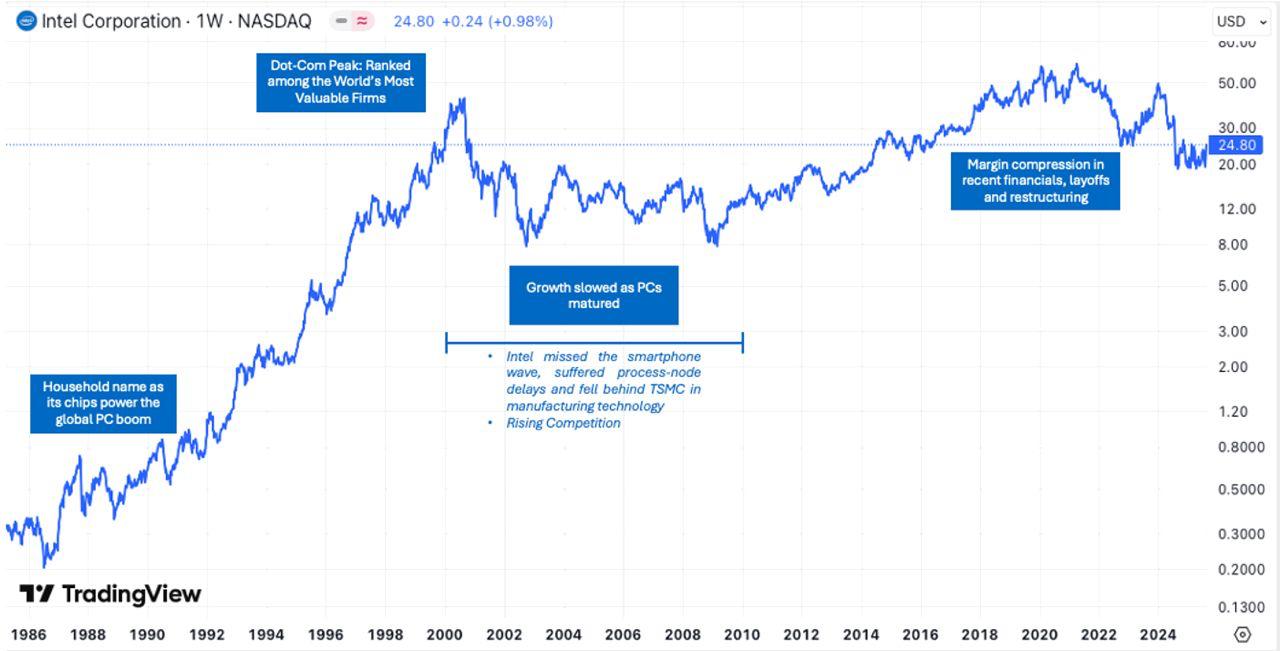
Intel’s story begins with innovation. Founded in 1968, the company pioneered semiconductor memory before launching the world’s first commercial microprocessor in 1971.
By the 1980s and 1990s, Intel became a household name, its chips powering the global PC boom. The “Intel Inside” campaign was more than marketing, it symbolised the company’s central role in the digital revolution. Here are some of its key highlights as well as low points.
- Early Success: Intel processors defined the PC era, securing over 80-90% of the x86 market during its peak.
- Dot-Com Peak: By 2000, Intel ranked among the world’s most valuable firms, emblematic of the tech boom.
- 2000s-2010s Decline: Growth slowed as PCs matured. Intel missed the smartphone wave, suffered process-node delays, and fell behind TSMC in manufacturing technology.
- Rising Competition: AMD’s resurgence, NVIDIA’s ascent in AI GPUs, and TSMC’s dominance in advanced nodes reshaped the landscape.
- Recent Financials: Margin compression, layoffs, and restructuring defined the early 2020s, underscoring the depth of Intel’s challenges.
Intel’s trajectory shows both the fragility of market leadership and the intensity of the semiconductor cycle.
The Turnaround Strategy
The Intel turnaround began under former CEO Pat Gelsinger, who laid out a bold “five nodes in four years” roadmap to regain process leadership.
In 2025, industry veteran Lip-Bu Tan assumed the CEO role, after Gelsinger was forced out, further refining that vision with a sharper focus on execution and customer alignment [2].
Key elements include:
- Massive Investment in Fabs: Projects in Ohio, New Mexico, and Europe aim to restore Intel’s global manufacturing footprint. Advanced packaging capabilities, such as the Foveros technology in New Mexico, are crucial for the chiplet era.
- Diversification Beyond PCs: Gone are the days when Intel’s future rose and fell with laptops and desktops. The company is chasing growth in AI accelerators (Gaudi 3), data centre processors, and even autonomous driving through Mobileye. Its FPGA arm, Altera, is also being repositioned to serve AI and edge workloads, with Silver Lake coming in as a strategic investor.
- Intel Foundry Services: A strategic pivot to offer contract manufacturing, competing directly with TSMC and Samsung. Landing Microsoft as an 18A customer was an important proof point, but the real test will be consistent, volume wins that prove Intel can deliver leading-edge chips on time. Foundry success is viewed as the linchpin of the recovery.
While ambitious, the strategy is resource- and capital-intensive, requiring both private capital and government support.
What’s Going On With Intel Right Now?
Intel’s turnaround is at a critical juncture. The company is still unprofitable, grappling with heavy capex and fierce competition, but external support has created new momentum for the company’s stock.
The Intel SoftBank Deal: A $2 Billion Infusion
In August 2025, SoftBank invested $2 billion in Intel, purchasing newly issued shares and taking roughly a 2% stake [3]. The move positioned SoftBank as a top-10 shareholder and lifted Intel’s stock in after-hours trading.
For Intel, the deal provides liquidity and credibility. For SoftBank, already invested in Arm and AI infrastructure, the partnership aligns with its ambition to build a broader chipmaking future.
Some market analysts speculate that the tie-up could eventually extend to Intel foundry operations, although no such commitments were announced.
US Government Support and Bailout Measures
Intel has also received extensive US government backing. Through the CHIPS Act and related initiatives, Washington has directed billions of dollars in subsidies and, most recently, a potential equity stake [4].
The US government views Intel as strategically vital: one of the last US-based advanced chipmakers and an essential part of national security and supply-chain resilience given its tech rivalry with China.
Equity Infusion and Foundry Speculation
Beyond SoftBank and government backing, Intel may pursue additional equity infusions, joint ventures, or spin-offs to sustain its turnaround. Market chatter continues to center on the Intel foundry business, which investors see as both a risk and an opportunity.
Market participants are closely monitoring whether the foundry can win external customers, which could influence Intel’s position in the global chipmaking sector.
Many investors feel the firm has suffered from being integrated, with Intel’s foundry customers (fabless firms) also being a competitor as Intel designed chips as an Integrated Device Manufacturer (IDM). Solving this underlying conflict of interest has been fiendishly difficult.
Intel’s Foundry Ambitions and Global Rivalry
Foundry services represent the cornerstone of Intel’s revival. Unlike in past decades, when Intel relied almost exclusively on its own product pipeline, the new strategy hinges on winning external clients at advanced process nodes.
- Technology Roadmap: Intel is pushing forward with 18A and 14A nodes, incorporating gate-all-around and backside power delivery, technologies that could restore leadership if executed on time.
- Customer Wins Needed: Cloud giants and major chip designers are evaluating Intel’s offerings, but widespread adoption remains unproven. Intel has acknowledged that without external foundry traction, the strategy could be reconsidered.
- Global Rivalry: TSMC controls nearly 70% of pure-play foundry revenue, with Samsung as the second player. Intel is attempting to break into this duopoly from a position of weakness, a task requiring flawless execution.
Analysts suggest that SoftBank’s stake could pave the way for collaboration, particularly in AI-driven semiconductor manufacturing.
Wider Semiconductor Industry Implications
Intel’s turnaround carries significance beyond corporate shareholders:
- National Security: As one of the last advanced chip manufacturers in the US, Intel’s success is intertwined with domestic defense, AI, and supply-chain security.
- Global Supply Chains: Heavy reliance on Asian foundries creates systemic risk. A competitive Intel foundry could reduce that concentration.
- Future of AI and Chipmaking: In the AI-driven semiconductor industry, the bottleneck is no longer just CPUs. There’s also advanced packaging, accelerators, and memory integration. Intel’s technologies give it a chance to be a neutral systems integrator if customers buy in.
Lessons From Intel’s Journey
Intel’s history offers insights for those following the semiconductor industry:
- Market Leadership is Never Permanent: Intel’s decline underscores how quickly competitors can seize an opportunity when incumbents falter.
- Turnarounds Require Deep Capital and Patience: In capital-intensive industries like semiconductors, strategy alone isn’t enough, external funding and subsidies are essential.
- Strategic Partnerships Matter: The Intel SoftBank deal highlights the growing role of outside investors and governments in sustaining critical industries.
- Execution is the Only Currency: Many analysts highlight that consistent execution — delivering competitive products on time and at scale — is a key factor observed by the market.
Where Next for Intel?
Intel’s turnaround is widely regarded as a case study within the semiconductor industry.
Once a symbol of American technological might, Intel now fights to prove that it can reinvent itself in the age of AI, advanced packaging, and global supply-chain realignment. The $2 billion Intel SoftBank deal is both a lifeline and a signal: Intel’s future remains strategically vital.
Whether the company can translate that support into foundry leadership and sustainable profitability will define not only its own trajectory but also the chipmaking future of the US and the wider world.
Reference
-
- “Intel gets $2 billion lifeline in the form of SoftBank equity investment – Reuters”. https://www.reuters.com/business/media-telecom/intel-gets-2-billion-lifeline-form-softbank-equity-investment-2025-08-19/ . Accessed 25 August 2025.
- “Intel appoints chip industry veteran Lip-Bu Tan as CEO – Reuters”. https://www.reuters.com/technology/us-chipmaker-intel-appoints-lip-bu-tan-its-ceo-2025-03-12/ . Accessed 25 August 2025.
- “Intel is getting a $2 billion investment from SoftBank – CNBC”. https://www.cnbc.com/2025/08/18/intel-is-getting-a-2-billion-investment-from-softbank.html . Accessed 25 August 2025.
- “Lutnick says Intel has to give government equity in return for CHIPS Act funds – CNBC”. https://www.cnbc.com/2025/08/19/lutnick-intel-stock-chips-trump.html . Accessed 25 August 2025.